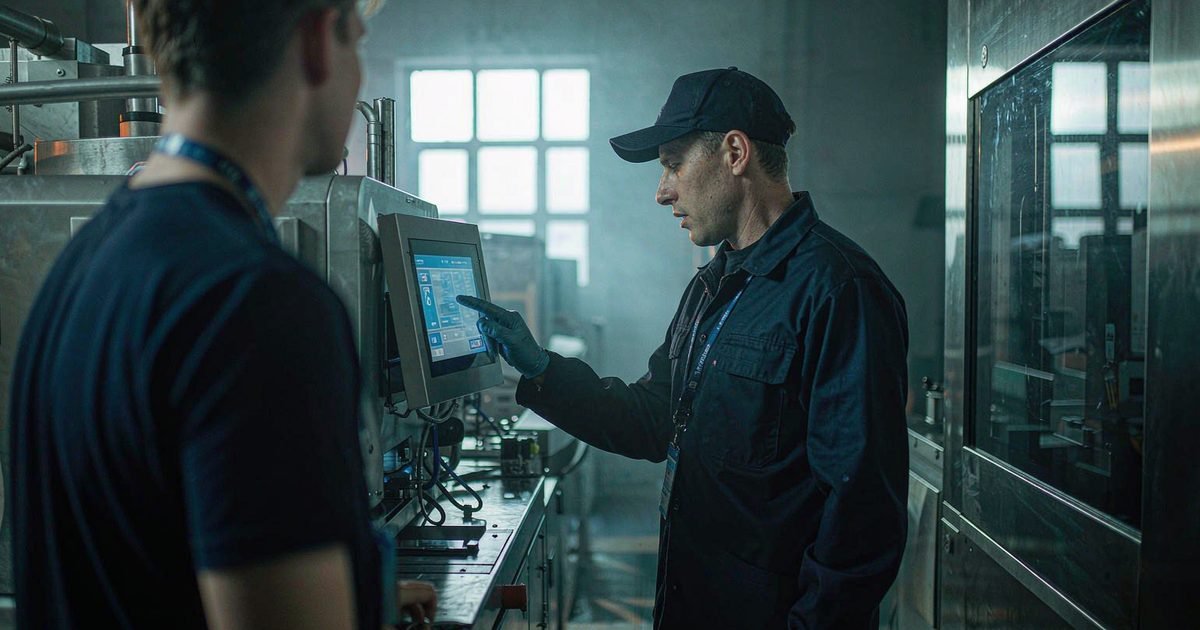
The machine is installed and the utilities are connected. Then the night shift starts: two operators who have never run a washer, a ramp-up window the planner has already booked, and a supplier whose training commitment reads as one tidy line — manuals and remote support. SMT operator training is the gap between those two facts, and most of it can be written into the purchase order before the machine ships.
The promise is not imaginary — it is just thin. We audited all 22 product pages on this site: every single one carries the same two service lines, English manuals and remote support. Only one page (the PCBA brushing machine) mentions the operator in any specific way, and none of the 22 promises structured video training. That is a fair picture of the industry’s baseline: documentation and a remote channel are standard; a named training plan is not. Which is exactly why the six modules below belong in your order documents, not in a hope. Source: CHUANGQI product page audit, 18 November 2026.
Key takeaways
- All 22 of our product pages promise manuals and remote support — that is the baseline, not a training plan.
- Put six modules in writing: familiarization, chemistry, daily checks, alarms, process setup, escalation.
- Video training appears on 0 of 22 product pages, so ask for it explicitly if your team needs it.
- Attach the module list to factory acceptance and commissioning, not to a conversation after delivery.
- A free sample test doubles as hands-on training for one of your process engineers.
What the Spec Sheets Actually Promise
Read any cleaning machine datasheet honestly and you will find two commitments about people, not machines: a manual in English and a support channel you can reach remotely. Both are genuinely useful. The manual is the audit trail your quality department will ask for; the remote channel is what turns a three-day problem into a three-hour one.
What the datasheet does not define is who on your side learns what, by when, and how you verify they learned it. That part is invisible in the spec table because it depends on your team: how many operators rotate across shifts, whether your process engineer has run a washer before, and how much of the process setup you want to own in-house. A supplier can commit to delivering knowledge; only you can commit to receiving it.
So treat the spec-sheet baseline as the floor, and define the rest yourself. The next section is that definition, in a form you can paste into a document.
Six Training Modules to Put in Writing
Each module has a scope, a deliverable and a moment. If a supplier cannot commit to a row of this table, that tells you something before you order, not after.
| Module | What it covers | Deliverable to request | When |
|---|---|---|---|
| 1. Machine familiarization | Layout, safety interlocks, loading and unloading, transport, emergency stop | Walkthrough checklist, signed by each operator | Commissioning day |
| 2. Chemistry handling | Fluid make-up and dosing, concentration checks, bath changeover and disposal paths | Written dosing instruction with fluid names | Commissioning |
| 3. Daily checks | The setpoints an operator can verify every shift without instruments | Daily-check sheet matching your machine model | First production week |
| 4. Alarm response | Common alarms, first actions, when to stop the line instead of retrying | Alarm table with escalation column | Commissioning |
| 5. Process setup | Recipe per board family, cycle structure, where parameters may be changed and by whom | Recipe sheet per board family | With your process engineer |
| 6. Escalation | Who to contact, what data to send, how a remote session is started | Contact path + one live remote session | Ongoing |
Two notes on scope. Modules 1 to 4 are operator-level; module 5 belongs to your process engineer, and you should resist letting it drift onto the operator desk, because an undocumented recipe change on one shift is how a good process quietly becomes an inconsistent one. Module 6 is the cheapest insurance in the whole table: a team that knows exactly what to send — photos, alarm codes, board and flux details — gets useful answers from any support engineer far faster than one that writes "machine not working."

Manual, Video, Remote or On-Site: Matching the Form to the Moment
The four delivery forms are not interchangeable. Each fits a different moment, and each has a failure mode of its own.
| Form | Best for | Watch out for |
|---|---|---|
| Manual | Reference after training; the audit trail quality teams ask for | Nobody reads it cover to cover — pair it with the walkthrough |
| Video | Memory refresh, shift handover, training new hires later | Rarely offered by default — request it for your machine configuration |
| Remote session | Fast diagnosis, parameter walkthroughs, module 6 practice | Needs a stable connection and someone on your side holding the camera |
| On-site | First commissioning, module 1 and 2 hands-on work | Schedule it against commissioning and acceptance, not after production pressure starts |
Most real programs end up hybrid: on-site for commissioning, remote for the first months of questions, manual as the permanent reference, and video wherever your team knows it will need a refresher. If video matters to your shift rotation, say so during quoting — that is a commitment a supplier can actually plan for, unlike a vague "full training" promise that means something different on every production floor.
Tie Training to Commissioning and Acceptance
The training plan gets teeth when it is attached to events you already control. Factory acceptance is the first one: every production batch passes a multi-stage test before shipment — spray-pressure calibration and watertightness, drying temperature uniformity, a 72-hour continuous trial run, and an ionic cleanliness reading taken from a witness board. If you witness any of that, you are not just checking the machine; your engineer learns what a healthy cycle sounds and looks like, which is knowledge no manual transmits. Our factory acceptance test checklist shows which clauses to put in the contract.
Commissioning is the second event: modules 1 to 4 land there naturally, on your floor, on your machine. The installation checklist covers what to prepare before that day so training time is not eaten by missing utilities or space problems.
And there is a third, often-missed opportunity. Before anything ships, you can send us sample boards for a free cleaning test — free of charge, with no purchase obligation, a reply to every request within 24 hours, and before-and-after videos plus a cleaning report and a machine recommendation in return. For your process engineer, that trial is the first real training session: your boards, your flux, your chemistry behavior, months before the machine arrives.
When you request a machine, ask for the training plan alongside the price. Send us your board dimensions and shift structure, and we will map the six modules onto your commissioning schedule with a technical response within 24 hours.