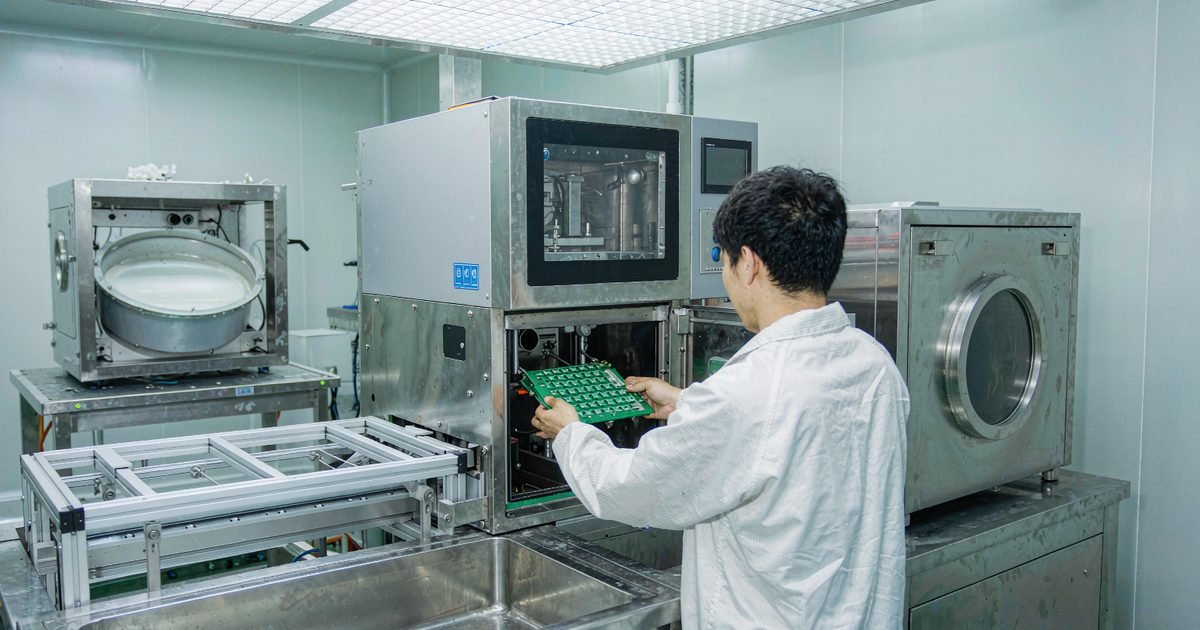
A cleanroom cleaning procedure controls where a board is handled, how it enters the wash step, and what leaves with it — not the air quality. If your wash step sits in an ISO Class 7 room and boards still fail cleanliness checks, start with material flow, not room class.
Here is the proof that the equipment market under-documents this. A field scan of all 22 CHUANGQI product pages found cleanroom information almost absent: just 2 pages state a cleanroom or ISO class explicitly, no page publishes an ISO cleanliness class for the equipment, and 8 of the 14 FFU references sit on the FFU product page. Source: CHUANGQI product page audit, 2026-11-25.
Key takeaways
- A cleanroom class controls airborne particles, not the residue a board carries into the wash step.
- Only 2 of 22 product pages state a cleanroom or ISO class explicitly.
- No product page publishes an ISO cleanliness class number for the cleaning equipment.
- Fix the board entry path and fixture return loop before upgrading air filtration.
- Send your board size and flow direction; receive a quote within 24 hours.
What a Cleanroom Cleaning Procedure Actually Controls
The definition below comes from a field scan of all 22 CHUANGQI product pages (audit date 2026-11-25), read against the cleanroom assembly constraint described in F-060.
Definition. A cleanroom cleaning procedure is the documented sequence that moves a loaded board from the solder or coating boundary, through the wash and dry stations, and back into controlled storage — including the fixture and carrier state at each handoff. It specifies direction of travel, who touches the board, and which surfaces are considered clean.
Why it matters. An ISO room class measures the air. It says nothing about the residue already on the board, the dust on a return carrier, or the fingerprints added when a board is re-clamped after drying. A wash step can meet every air-quality requirement and still recontaminate a board at the exit table.
Actionable step. Draw the board path on the floor first. Mark one entry and one exit. Anything that crosses back — a carrier returning from the inspection bench, a fixture reused from a standard SMT area — is a contamination route that your room class will not close.
The 6 Material-Flow Checks
Run these checks on the real line, with the real fixtures, before you write the procedure. Each one ends in a record you can audit.
| Check | Failure mode it catches | Record to keep |
|---|---|---|
| 1. Load direction | Dirty and clean boards share a path | Floor flow sketch, signed |
| 2. Fixture condition | Carrier from the standard line enters the room | Fixture ID + last wash date |
| 3. Dwell before wash | Flux residue ages in the rack | Timestamp at solder and at load |
| 4. Board contact points | Re-clamping after dry adds handling residue | Touch-point map |
| 5. Air make-up at the wash | Local extraction pulls dirty air over the wet board | Airflow direction photo |
| 6. Exit handoff | Clean board lands on an uncontrolled bench | Receiving surface check |
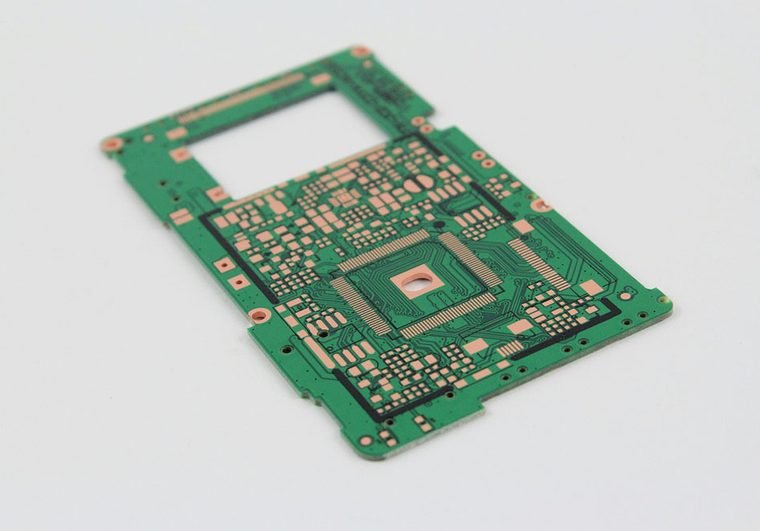
Check 2 is the one most often skipped. A fixture that has run in a standard SMT area is not made clean by entering a cleanroom. Our FFU fan filter unit page and the substrate cleaning and dust removal machine page describe the two halves of the problem: particle control in the air, and particle removal from the board before it enters the room’s critical zone.
What 22 Product Pages Reveal
Conclusion. Cleaning-equipment datasheets are written around throughput, tank volume and utility connections. They rarely describe how a machine behaves as a cleanroom asset. That is a documentation gap, not proof that the machines cannot operate there.
| Field checked | Pages | Share |
|---|---|---|
| Cleanroom or ISO class stated | 2 / 22 | 9% |
| ISO cleanliness class number published | 0 / 22 | 0% |
| Any clean-environment term present | 6 / 22 | 27% |

Source: CHUANGQI product page audit, 2026-11-25; reproducible with the field-scan script in our working log. The practical reading: a supplier’s silence on cleanroom integration is normal, so the buyer has to write the requirement. Ask for the airflow direction around the wash chamber, the surface finish of the parts that touch the board, and the fixture-cleaning method — not a certificate.
Per a 2026-11-11 industry announcement, a North American EMS provider added an ISO Class 7 cleanroom at a Changzhou facility to expand medical-device assembly. That is a capacity decision, and it creates exactly this material-flow problem: a cleaner can be installed in the room while the boards arriving at it still come from a line that was never designed for controlled transfer.
When This Approach Does Not Apply
This material-flow discipline is not worth the paperwork if you wash only bare boards that go straight into plating, or if your customer accepts the cleanliness result on the incoming board without a post-wash check. It also adds little where the wash step is fully outside the controlled area and the board is re-bagged before it crosses the boundary.
For lines that do need it, the equipment side is straightforward. Our guide to medical-device PCB cleaning in a cleanroom covers what an ISO class cannot remove, and the inline PCBA water cleaning machine is the usual starting point when the wash step must sit inside the flow rather than beside it.
Next step: send us your cleanroom cleaning requirements with the board dimensions, the carrier type, and the direction the boards must travel. We will map the wash step into that flow and send a quote within 24 hours.
FAQ
Does a higher ISO class remove the need to control board handling?
No. The room class governs airborne particle concentration. Residue on the board, dust on a return fixture, and handling after the dry stage sit outside that measurement. Control the material flow first, then size the room.
Where should the wash step sit relative to the cleanroom boundary?
Put it where the board’s contamination state changes, not where the building layout is simplest. If the incoming board is dirty from soldering, the wash step is the boundary; the dry exit belongs inside the controlled side.
What records should follow a board through a cleanroom wash step?
At minimum: the fixture ID and its last cleaning date, the solder-to-wash timestamp, and a touch-point map for any re-clamping after drying. These three records close most of the audit questions that a room-class certificate cannot.
Can one cleaning machine serve both a cleanroom and a standard SMT area?
Physically yes, but the return path then becomes the weak point. If the same carrier moves between the two areas, it needs its own defined wash and storage state before it re-enters the room. Otherwise you are moving contamination on the fixture.
What should I ask a supplier before placing a cleaner inside a cleanroom?
Ask for the airflow direction at the wash chamber, the materials of every part that touches the board, the fixture-cleaning method, and the machine’s stated footprint. Treat a missing answer as a requirement you must write into the purchase order.