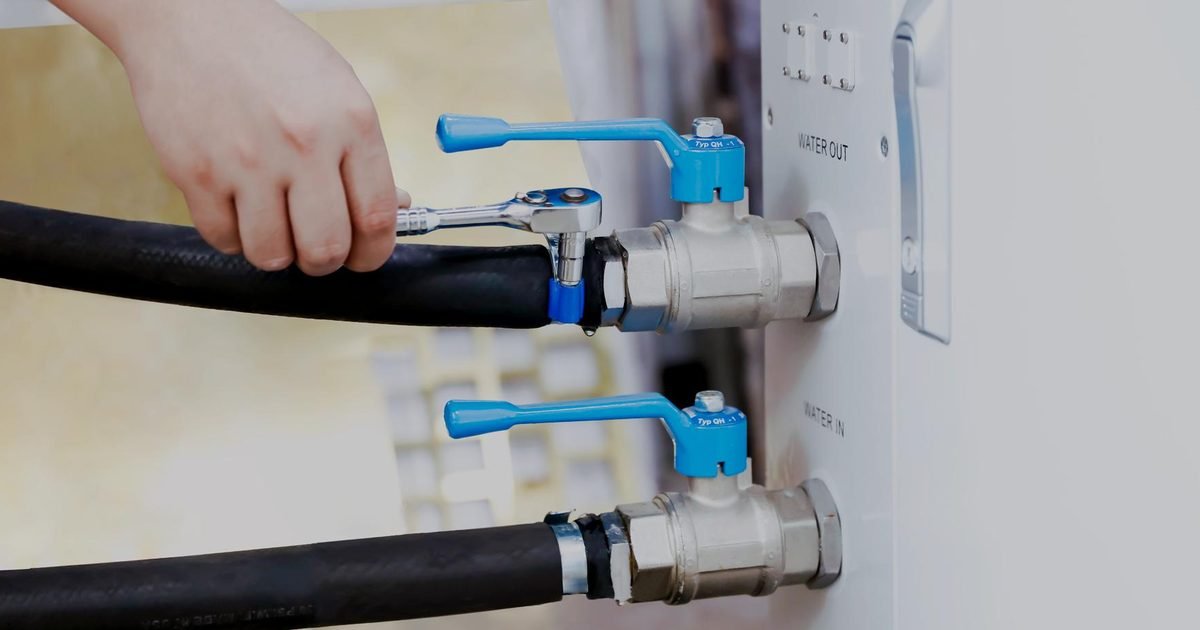
The problem. A washer that cleaned well on Monday leaves a dry stripe down the middle of the panel by Thursday, and the reflex is to add detergent. The cause is usually scale: minerals plate onto the nozzle orifice and the heater as rinse water evaporates, the jet narrows, and coverage disappears without an alarm. Separate scale from chemistry with four signals, then descale on evidence rather than a calendar.
The proof. Our own records are thin, and that is the point. In our Search Console export for 17 September to 22 November 2026, the query descaling nozzles clogging drew 4 impressions at an average position of 18.50 with no clicks, and nozzle maintenance drew 4 impressions at 20.00. On the supply side, an audit of all 22 product pages we publish found rinse-water resistivity stated on 3 pages, a filtration grade on 4, a spray-pressure band on 4 — and water hardness on none, a descaling interval on none. Source: CHUANGQI product-page audit, 2026-11-27.
Key takeaways
- Scale is mineral, not organic. Detergent cannot dissolve it and extra dosing makes the deposit worse.
- Across 22 published datasheets, 3 state rinse resistivity and 0 state water hardness.
- Our offline washer specifies rinse resistivity above 15 MΩ (CQ-C743 datasheet).
- Swap one nozzle to test: if the dry stripe moves, the cause is scale.
- Descale heater and pipework with the builder’s acid, never a chloride-based one on 304 stainless.
What Scale Actually Is Inside a PCB Washer
In plain terms. Scale is the hardness mineral in water — calcium and magnesium carbonate — that leaves solution and plates onto hot or drying surfaces inside the machine: heater elements, spray-pipe interiors, nozzle orifices and rinse-section walls. It is inorganic, so a detergent built for flux residue has little to act on. The deposit grows until the orifice cross-section and the heat-transfer surface both change.
The cost of getting it wrong. Three contaminants fail the same way — a board comes out wet or hazy in the wrong place — and each needs a different response. Flux residue is organic and the wash chemistry removes it. Solder paste is metallic and the filtration loop captures it. Scale is mineral and only an acid descaler lifts it. Treating scale as a chemistry problem is how a plant ends up dosing at the top of the published band and still shipping dry stripes.
How the deposit builds, cycle by cycle. Rinse water carrying hardness enters the rinse section. The drying stage heats the pipework around it. Water evaporates at the nozzle tip between cycles and leaves its mineral content behind. The next cycle deposits another layer on top of the last one. On identical water, a three-shift line carries the deposit further than a one-shift line, because the wet-dry cycle repeats more often — a mechanical effect, not a change in water quality.
Four Signals, Read in Order, That Rule Scale In or Out
Read them in this order. Each one rules something out, and the first costs nothing.
- The dry stripe moves when you swap a nozzle. Remove the nozzle covering the stripe, fit a spare, run one board. If the defect follows the new nozzle’s lane, the orifice is blocked. If it stays put, look upstream at spray-pipe pressure or conveyor height. This is the cheapest test available and the one most often skipped in favour of a chemistry change.
- The wet flow falls while the gauge holds. The CQ-C743 sheet specifies spray pressure of 30–40 psi, and a partly blocked header can keep that reading while delivering less volume, because the restriction moves the pump’s operating point. Read the flow meters before the gauge, and treat a stable pressure as no evidence either way.
- Detergent consumption climbs while cleanliness falls. The CQ-C9610 sheet lists detergent use at 1.0–2.5 L/h. If you are dosing at the top of that band and still finding residue, the chemistry is being spent on a problem it cannot solve.
- A white ring on the nozzle tip, or a chalky film on the heater. Visual confirmation, and worth a photograph. The next question from maintenance will be whether the deposit is soft and dark (organic) or hard and crystalline (mineral).
Three Spec Fields Predict Scaling — Most Datasheets Omit All Three
A datasheet that states rinse-water quality, filtration grade and spray pressure lets a buyer predict scaling before the machine arrives. We audited our own 22 product pages field by field, counting a field only when the specification table carries a value — a sentence in the page text does not count.
| Field | Published on | Why it decides scale |
|---|---|---|
| Rinse-water resistivity | 3 of 22 pages | Sets how much dissolved mineral reaches the rinse section |
| Filtration grade | 4 of 22 pages | Removes the particles that seed crystal growth |
| Spray-pressure band | 4 of 22 pages | Gives the baseline your gauge should read |
| Water hardness | 0 of 22 pages | The variable that actually drives the scale rate |
| Descaling interval | 0 of 22 pages | Nobody publishes one, including us |
Source: CHUANGQI product-page audit, 2026-11-27. The audit covers every product page we publish; each figure in the table above can be re-derived page by page from the specification tables themselves.
Two machines in our range publish enough to work from. The CQ-C743 offline PCBA cleaning machine states DI-water resistivity above 15 MΩ, a DI inflow of 0.5 m³/h, 0.45 µm filtration on the chemical-recovery and DI-drain circuits, and a 304 stainless body. The CQ-C9610 inline water cleaning machine states DI resistivity above 15 MΩ, DI inflow of 1.0 m³/h, a corrosion-resistant PP body and a SUS316 mesh belt. Neither sheet states water hardness, because that number belongs to your plant, not to a supplier’s brochure.
Steps That Lift the Deposit Without Scoring the Orifice
- Prove it first. Run the nozzle-swap test. Descale only after the stripe follows the nozzle, otherwise you have spent a shift and a drum of acid on a conveyor-height problem.
- Read the water at the rinse inlet. Resistivity below the published figure — above 15 MΩ on both CQ-C743 and CQ-C9610 — points at the DI loop rather than the machine. A resin bed that needs regeneration mimics a scaled nozzle.
- Isolate the circuit. Descale heater and spray pipework as a separate loop. Acid circulated through a tank still holding detergent spends itself neutralising the detergent, and the heater stays coated.
- Use the builder’s descaler, at the builder’s temperature. Chloride-bearing acids attack the passive layer on 304 stainless, which is the body material on the CQ-C743; the corrosion shows up months later as pitting, not as a leak on the day.
- Re-baseline the machine afterwards. Restore spray pressure to the published band, then verify with a test board. The routine we run at dispatch covers spray-pressure calibration, a 72-hour continuous run-in and an ion-cleanliness check on a test board (source: CHUANGQI factory inspection procedure).
Not suitable for
- Organic blockage. A soft dark deposit is flux or paste. Acid will not move it; clean or replace the nozzle instead.
- Rodding an orifice with wire. It scores and enlarges the hole, and the pattern never returns to the one the machine was accepted on.
- Machines awaiting factory acceptance. Descale before the acceptance test, not after, or the test measures your water instead of the machine.
- Softened water sold as a fix for the rinse section. A softener exchanges hardness for sodium; it does not deliver the resistivity a rinse section is specified against. Treat the two loops separately.
Scale is one line in a longer routine. Our maintenance schedule for a PCBA cleaning machine puts water quality and nozzle inspection on the same weekly card, and the decision guide for changing cleaning solution covers the chemistry side so the two problems stop being confused for each other.
Next step: send the rinse-water resistivity reading, the hardness figure from your water supplier and the nozzle count on your machine. We reply with the descaler procedure for that model and a quote within 24 hours.
FAQ
How often should a PCB washer be descaled?
On evidence, not on a calendar. No datasheet in our 22-page audit publishes an interval, so the honest starting point is your own water hardness plus a monthly nozzle-swap check. Once the stripe test starts failing within a month of a clean, the interval is shorter than a month.
Can white vinegar be used to descale a cleaning machine?
It is an acid and it will lift light carbonate scale, but it is not the builder’s specification. On a machine with a 304 stainless body the question to ask is what the descaler contains, not how strong it is — chloride content matters more than pH for stainless.
Does hard water damage the boards or the machine?
The machine first. Scale on a heater slows heat transfer and scale in a nozzle narrows the jet, while the boards show it later as water spots or hazy residue. A rinse section specified above 15 MΩ is designed around water that has already had the hardness removed.
Will a water softener stop nozzle scaling?
It reduces hardness and therefore slows the deposit, but it does not produce rinse-grade water on its own. Softened water still carries dissolved solids; a rinse section specified above 15 MΩ expects a DI stage behind the softener, and the resin has to be regenerated on schedule.