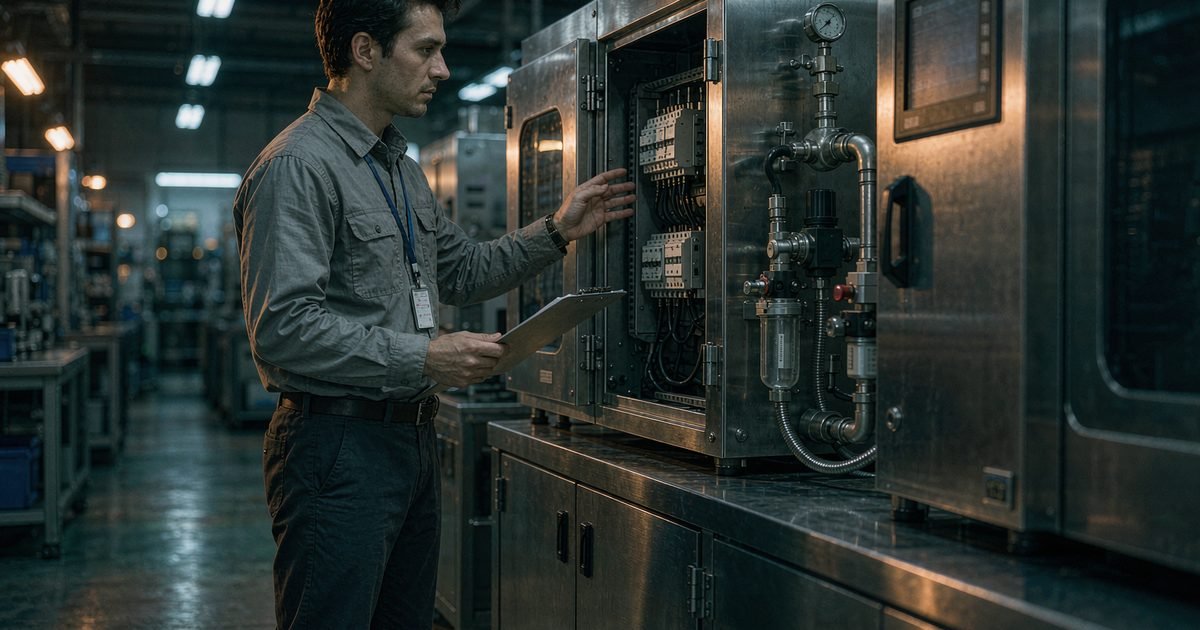
A cleaning machine installation checklist exists to close five utility figures before the machine ships: power, compressed air, water, exhaust and noise. This audit of 21 specification tables from CHUANGQI, a manufacturer of SMT and PCBA cleaning equipment, shows which of the five are published, and which ones have to be confirmed in writing instead of assumed.
We parsed the specification table of every product page on chuangqitech.com on 10 November 2026. Twenty-one of 22 pages carry a spec table; the twenty-second page describes a water-based cleaning fluid, not a machine. Power appears on 14 of those 21 pages, compressed air on 14, water on 6, exhaust on 5, noise on 4. Labelling is not standardised either: nine different field names carry the power figure across those 14 pages, from Power Supply and Power Input to Total Power, Max Power and Machine Power. Every count below is reproducible by scanning the spec-table rows one row at a time.
Key takeaways
- Power appears on 14 of 21 spec tables, written under nine different field names.
- Water supply or DI water figures appear on only 6 of 21 pages.
- Exhaust is published on 5 pages and noise on 4.
- Confirm all five utilities in writing before shipment, not at commissioning.
- Published limits are machine ceilings, not site-connection drawings.
Power Is Published on 14 of 21 Pages, Under Nine Different Field Names
The power figure is the one facility teams ask for first, and it is also the most fragmented. Fourteen pages publish it, but the reader has to know that Operating Voltage 220 V/50 Hz, Power Input AC380V50HZ, Power Requirement 3PH, 380 VAC, 5 wires, Max Power 27 kW and Total Power 30KW all describe different halves of one question: what has to arrive at the terminal.
For an installation checklist the practical consequence is short. A page that lists only a wattage gives you the load, not the supply. A page that lists only a voltage gives you the supply, not the cable or breaker sizing. Both columns are needed, and on the same page they sit under different labels.
| Utility | Pages publishing it (of 21) | Field names used | Confirm in writing if absent |
|---|---|---|---|
| Power | 14 | 9 | Voltage, phase, frequency, full-load current, cable entry |
| Compressed air | 14 | 5 | Pressure at machine inlet, consumption, dew point, pipe thread |
| Water supply | 6 | 6 | Inlet pressure, resistivity or hardness, flow, drain point |
| Exhaust | 5 | 2 | Duct diameter, airflow, permissible back pressure |
| Noise | 4 | 1 | Sound pressure level, measuring distance and condition |
| Control and communication | 5 | 2 | Protocol, I/O list, MES or host interface |
| Ingress protection | 3 | 1 | IP rating of the wet zone |
Source: CHUANGQI product specification audit, 2026-11-10, covering 21 of 22 product pages. Counts are per page, not per value; a page publishing two power fields counts once.
What the Other Four Utilities Publish, and What They Leave Out
Compressed air is the best-covered utility after power, at 14 pages, but its five field names split into two families: supply quality (Compressed Air, External Air Supply) and consumption (Air Consumption, Air Flow Rate). A plant that sizes a compressor from a consumption figure alone can still starve the machine at the inlet.
Water is where the gap is widest. Six pages publish a water figure, and only the PCBA water-cleaning models publish quality as well as pressure: the CQ-C9610 inline PCBA water cleaning machine lists DI water resistivity above 15 MΩ, an inflow of 1.0 m³/h and consumption of 10–16 L/min, while several stencil cleaners publish only an inlet pressure of 0.2–0.3 MPa. Resistivity is a water-quality spec, not a cleanliness result, and the two should never be written as one.
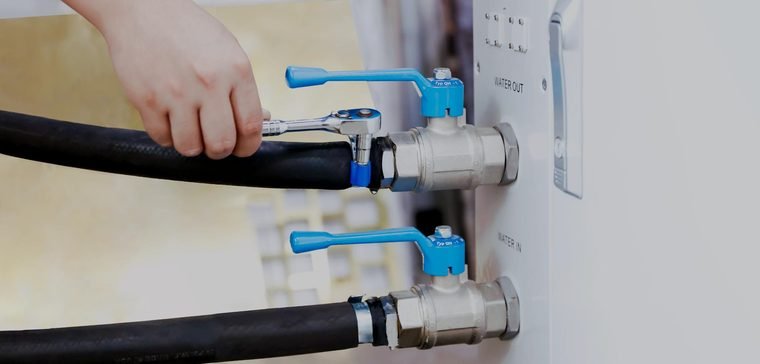
- Exhaust: 5 pages, and the two field names mean different things — Exhaust Port gives a flange size such as ⌀125 × H25 mm, Exhaust Duct gives a duct diameter such as 125 mm. Neither is an airflow figure.
- Noise: 4 pages publish a number (below 50 dB on the dual-frame and multi-function spray stencil cleaners, under 70 dB on the inline and offline PCBA washers). None of the four states the measuring distance.
- Control and communication: 4 pages name a controller (touchscreen plus PLC); 1 page publishes a communication field at all — MES integration and SEMI I/O, and it belongs to one model only: CQ-CL350S, the substrate cleaning and dust removal machine.
- Ingress protection: 3 pages, all three dry-ice machines rated IP55. The wet-zone machines publish no IP rating.
The fixture and pallet cleaner CQ-C756 works as a control case because it publishes the full facilities set: inlet water 0.1–0.3 MPa, compressed air 0.4–0.6 MPa, a 125 mm exhaust duct, 380 V/50 Hz three-phase five-wire at 27 kW maximum. That combination is what a facilities drawing needs, and it is the exception across the range rather than the pattern.
Where the Numbers Stop Being Enough
A published figure answers the question the manufacturer chose to answer. Before it reaches a facilities drawing, three limits apply.
Units are not harmonised across pages. Rated power appears as W on two pages, as kW on three, and as KW on six more; the remaining three pages list a voltage or current figure only. Water appears as m³/h in one field and L/min in the next field of the same table. Convert first, then compare, or the checklist itself becomes the error.
A supply figure is not a connection figure. Three-phase five-wire 380 V/50 Hz and single-phase 220 V/50 Hz are different installations, not different settings. Cable entry, breaker rating and earthing arrangement cannot be derived from the voltage line alone.
A port diameter is not a flow figure. The five exhaust entries give a flange or duct size. Duct sizing needs airflow and permissible back pressure, and neither is published.
This audit is not a substitute for the site-connection drawing: it shows which numbers exist in public, not where the cable tray runs or what else shares the breaker. Ask for the connection drawing with the quotation and keep the two documents separate.
Turn the Table Into a Pre-Shipment Question List
Five questions close the gap, and all five belong in the RFQ rather than in commissioning week. Each has a specific answer format, which is what makes it usable.
- What is the full-load current at the specified voltage, and what cable entry does the cabinet have?
- What inlet pressure and consumption does the machine need, and at what dew point?
- If the process uses DI water, what resistivity and flow must the supply hold, and where does the drain go?
- What duct diameter and airflow does the exhaust require, and what back pressure can the fan see?
- At what distance, and under what condition, was the published noise level measured?
Answers to those five turn a specification table into an installation scope. They also expose the one thing a datasheet cannot settle: whether the bay you have is the bay the machine needs.
CHUANGQI publishes a specification table for every model, and before release every production batch passes a drying-temperature uniformity check, water-tightness testing and spray-pressure calibration, then runs for 72 hours without a stop, followed by an ionic cleanliness verification on sample boards. If you are building the bay now, send the utility figures you already have together with your board size and we will confirm the machine-side numbers; you receive a quote within 24 hours. The footprint and access side of the same decision is set out in sizing the cleaning station on an SMT line, and the checks that run after installation start with the daily operator checklist.
Send your utility and board data for a machine-side confirmation
What utilities does a PCBA cleaning machine need?
A PCBA cleaning machine needs electrical power, compressed air, a water supply for the wet stages, an exhaust connection and a floor area rated for the machine weight. The five are published to very different degrees: across 21 CHUANGQI spec tables, power appears on 14 pages and water on 6.
Do I need to confirm voltage before the machine ships?
Yes, and the confirmation has to name phase and frequency, not only voltage. The range includes 220 V/50–60 Hz single-phase models and 380 V/50 Hz three-phase five-wire models; those are different installations, not switchable settings.
How much compressed air does a cleaning machine use?
Consumption depends on the machine family: a pneumatic stencil cleaner runs on air alone, while a water-based PCBA washer uses air mainly for blow-off and valve actuation. Fourteen of 21 pages publish an air figure, split between supply quality and consumption, so both values are needed to size a compressor.
Does a stencil cleaner need an exhaust duct?
Five of 21 pages publish an exhaust connection, and the stencil models are among them, with ports such as ⌀125 × H25 mm. Duct sizing still needs airflow and permissible back pressure, which the spec tables do not publish.
Where do I find the noise level of a cleaning machine?
Four of 21 pages publish a noise figure: below 50 dB on the dual-frame and multi-function spray stencil cleaners, under 70 dB on the inline and offline PCBA water washers. None states the measuring distance, so treat the number as a machine-class indication rather than a workplace exposure prediction.