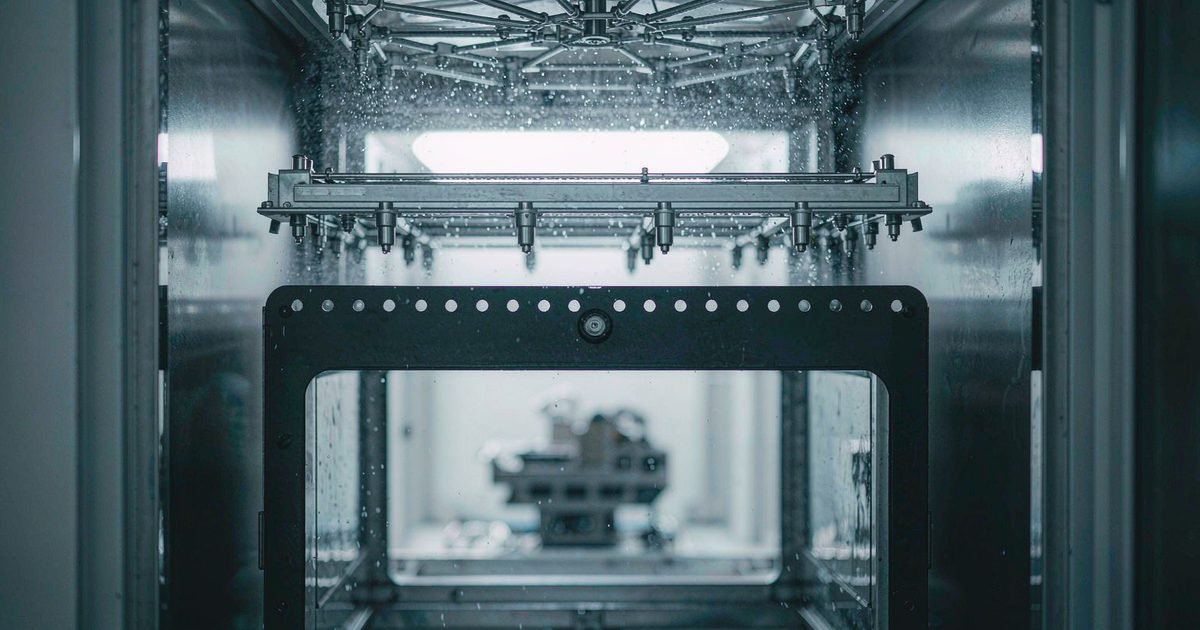
Choosing an SMT stencil cleaning machine comes down to six checks you can run before you ask for a quote. Our own range spans pneumatic, electric and dual-frame designs, and the specification tables disclose the differences unevenly. The comparison below runs on published hardware facts, not brochure adjectives.
We audited the five stencil-cleaner specification tables on chuangqitech.com on 12 November 2026: the CQ-C730 pneumatic stencil cleaner, the CQ-C730S automatic screen cleaning machine, the CQ-C740, the CQ-C750 multi-function spray machine and the CQ-C750S dual-frame machine. All five publish tank volume. Two of five publish a three-cartridge cascade running from 10 µm down to 1 µm. One publishes rinse-water resistivity monitoring with a 0–18 MΩ range. Two publish machine noise (below 50 dB). One cleans two frames per cycle. None publishes a detergent dose rate. Every count below comes from those tables, one spec row at a time.
Key takeaways
- All five stencil-cleaner pages publish tank volume; only 2 of 5 publish filtration stages.
- Drive type shapes the installation (air vs 380 V wiring), not the cleanliness result.
- Three-stage cartridge filtration (10 µm down to 1 µm) is the published spec that protects bath life.
- The dual-frame machine doubles frames per cycle; hourly output still needs a cycle time.
- Confirm dose rate, exhaust airflow and noise measurement conditions in writing.
What the five stencil-cleaner spec sheets publish
The audit covered the spec rows of the CQ-C730, the CQ-C730S, the CQ-C740 electric machine, the CQ-C750 and the CQ-C750S dual-frame machine. A row only entered the count when its table cell showed a number with a unit attached; the table columns below are read from the same sheets.
| Machine | Drive | Frames per cycle | What that page publishes |
|---|---|---|---|
| CQ-C730 | Pneumatic | 1 | 40 L single tank; cartridge cascade ending at 1 µm |
| CQ-C730S | Pneumatic | 1 | 360° rotating dual-side equal-pressure spray, named as the process |
| CQ-C740 | Electric | 1 | Rinse resistivity monitor (0–18 MΩ); optimal fluid charge 35 L × 2 |
| CQ-C750 | Electric | 1 | Four 42-litre baths — wash fluid kept apart from rinse |
| CQ-C750S | Electric | 2 | Two frames per cycle; otherwise mirrors the CQ-C750 tank layout |
Source: CHUANGQI stencil-cleaner product-page audit, 12 November 2026, five pages. Counts are per page; a page publishing two tank fields counts once, and several rows appear on both pages of a family.

Six checks that decide the quote
- Drive type. The CQ-C730 and CQ-C730S run on 0.4–0.6 MPa external plant air — the CQ-C730 page states there is no electricity in the wet zone, and the CQ-C730S follows the same air-driven layout — while the CQ-C740 electric stencil cleaning machine and the CQ-C750 pair take 380 V/50 Hz with 30 kW total power. This check decides your installation scope — air line, wiring and the wet-zone safety layout — before it decides anything about cleanliness.
- Frames per cycle. Four machines carry one frame per cycle; the CQ-C750S takes two. Capacity quotes should be written as frames per cycle first, because an hourly figure can only be derived after a cycle time is agreed (more on that below).
- Tank split. The CQ-C750 family runs four 42-litre baths and keeps wash fluid in a separate tank from rinse; the CQ-C730 family works from a single 40 L tank. A physical split keeps detergent carry-over out of the rinse stage, which matters once rinse quality becomes an acceptance item.
- Filtration stages. The CQ-C730 and CQ-C730S publish a cartridge cascade — 10 µm first, 5 µm next, 1 µm last. The other three pages list no filtration field at all — absence is not absence of filters, but it does mean the staged-filtration plan is a question for the quote rather than a fact on the table. Bath life consequences are set out in our filtration and bath-life guide.
- Rinse quality monitoring. The CQ-C740 publishes a resistivity monitor spanning 0–18 MΩ; no other page in the family publishes one. If your acceptance criteria hang on rinse-water quality, ask where the sensor sits and what value triggers an alarm — a monitor range is not a setpoint.
- Installation envelope. Published weight is 300 kg on the pneumatic pair and about 500 kg on the electric machines. Exhaust rows differ by family: the CQ-C730 pair gives ⌀125 × H25 mm, the CQ-C740 gives W124 × H30 mm, and the CQ-C750 pair lists no exhaust row at all. Only the CQ-C750 pair publishes noise, below 50 dB, and none of the five states a measuring distance or an exhaust airflow figure.
Where the spec sheets stop
Three gaps repeat across all five pages, and each one has a written-answer fix.
No dose rate. Zero of five pages publish a detergent dose rate or concentration window, so chemical consumption cannot be compared from the tables alone — ask for litres per hour at your paste load.
Port size is not airflow. The exhaust row gives a flange size; duct sizing needs an airflow figure and a permissible back pressure, and neither is published.
Noise without conditions. The below-50 dB figures carry no measuring distance, so treat them as machine-class indications rather than workplace-exposure predictions.
One process note balances the table: before any machine in the range ships, each production batch passes water-tightness testing and a drying-temperature uniformity check, gets its spray pressure calibrated, then runs 72 hours without a stop, closing with an ionic cleanliness verification on sample boards. What the datasheet leaves out is exactly the kind of item those checks and the quotation are for.
Send your frame size, paste type and daily frame count, and we will map them to the right machine and return a quote within 24 hours. Start at the electric stencil cleaning machine or compare the wipe-versus-machine economics in the three-year TCO comparison.
FAQ
Pneumatic or electric stencil cleaner — which one?
Decide by utilities first. If the line cannot route 380 V power to the wet zone, the pneumatic pair (CQ-C730, CQ-C730S) runs on plant air alone. Where power is available, the electric machines add tank separation and, on the CQ-C740, rinse resistivity monitoring.
What tank volume does stencil cleaning need?
The published range runs from a single 40 L tank to four 42-litre baths split across wash and rinse. The right answer depends on frames per day and changeover frequency, which is why dose rate and bath-life data belong in the quote rather than in the spec table.
Why do only two pages publish filtration stages?
Filtration is published where the process makes it a selling point: the pneumatic family lists 10, 5 and 1 µm cartridge stages in line with its paste-removal role. On the other machines, absence of the field means the filtration plan has to be confirmed in writing, not that filtration is missing.
Does a dual-frame machine halve my cleaning time?
No — it doubles frames per cycle. Hourly output depends on the cycle time, and no single cycle time applies across the five models because the setting is agreed per stencil and soil load. Quote capacity in frames per cycle, then measure the cycle on your own boards.