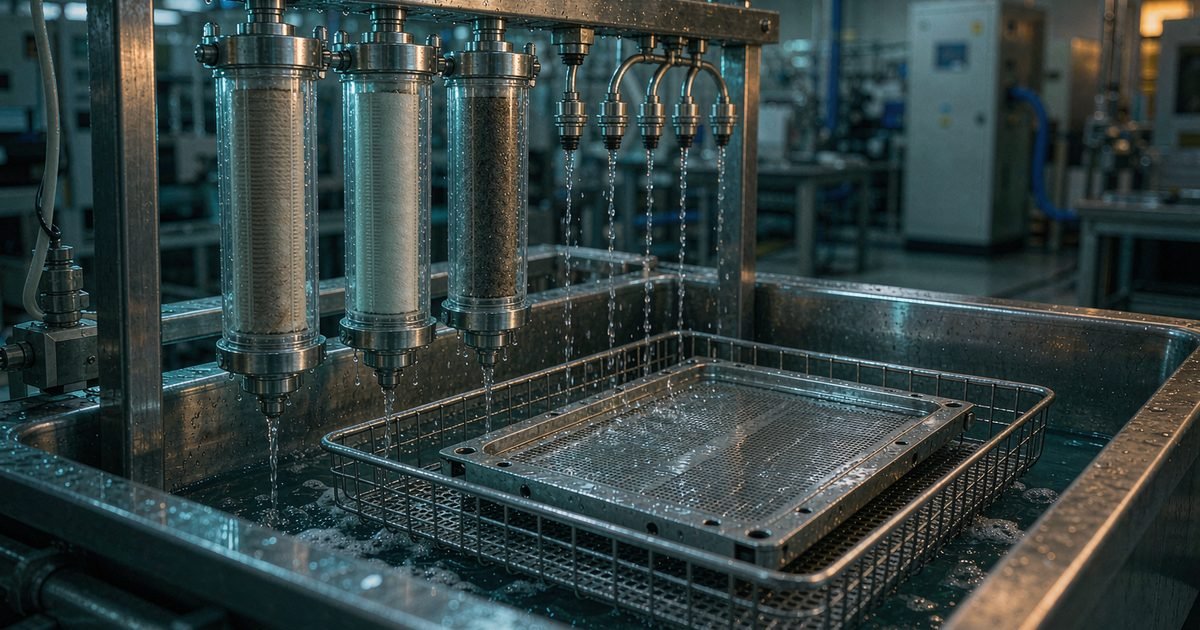
On an SMT line, the maintenance engineer usually sets the stencil cleaning bath change by calendar. That is the wrong clock: the bath ends when the cartridges ahead of it stop holding solids. Bath life is a filtration question first.
CHUANGQI publishes those stages instead of one aggregate rating. The CQ-C730 and CQ-C730S pneumatic and automatic screen cleaning machines carry 10 µm, 5 µm and 1 µm cartridges ahead of a 40 L tank, with a 2–4 min wash and a 2–5 min dry. The CQ-C770 squeegee cleaner stages the same three ratings behind a 50 L tank at a 40 L optimal charge, with wash and dry cycles adjustable from 1 to 15 min. The CQ-C743 offline PCBA cleaner uses 0.45 µm filtration on both its chemical recovery loop and its DI drain. Before shipment every unit is calibrated for spray pressure, run continuously for 72 hours, and checked for ionic cleanliness using sample boards.
Key takeaways
- Bath life is set by cartridge loading, not by fluid age or tank size.
- The CQ-C730 family publishes three stages — 10, 5 and 1 µm — on a 40 L tank.
- The 0.45 µm loops on the CQ-C743 protect the DI side, not the wash bath.
- A cartridge retains particles; dissolved ionic load still needs a cleanliness test.
What Each Filtration Stage Removes
Filtration stage means one cartridge in a series, each with a published pore rating, and the rating describes the particle size that cartridge is specified to retain. It says nothing about how much mass it can hold before it blinds. That distinction is the whole reason three stages exist instead of one.
Stage 1 — 10 µm, debris and labels. This cartridge meets the coarse fraction first: stencil tape residue, label fibre, dried paste flakes, solder balls knocked off the aperture field. It loads fastest by mass and it exists to keep the two cartridges behind it from doing work they were not sized for. When stage 1 blinds early, the cause is usually handling and consumables, not the cleaning chemistry.
Stage 2 — 5 µm, solder paste and rosin particles. This is the working stage for the contamination that actually matters to print quality. Paste and rosin particles in this band are the ones that redeposit in apertures and on the stencil underside. A loaded stage 2 shows up as rising wipe frequency long before the bath looks dirty.
Stage 3 — 1 µm, fine solder paste and rosin particles. The final stage before fluid returns to the spray bar. Treat it as a polisher: it protects the nozzles and the spray pattern, and by design it holds the least mass of the three. Reading stage 3 as the primary filter is a common misread, and it is why some baths are changed while stage 2 is still half loaded.
A fourth architecture sits on a different loop entirely. On the CQ-C743, 0.45 µm cartridges sit on the chemical recovery line and on the DI drain, and the machine publishes a DI rinse above 15 MΩ with a 0.5 m³/h inflow. Those cartridges protect the rinse side and the drain, so they extend bath life only indirectly. The CQ-C740 electric stencil cleaner, outside the three families tabulated below, takes the same logic one step further and publishes a resistivity monitor across 0–18 MΩ, so rinse quality is read on an instrument instead of assumed from a colour.
| Machine family | Filtration published | What the stage protects | Published operating value |
|---|---|---|---|
| CQ-C730 / CQ-C730S | 10, 5, 1 µm, three stages | Wash fluid returning to the spray bar; 40 L tank | 2–4 min wash, 2–5 min dry |
| CQ-C770 | 10, 5, 1 µm, three stages | Wash fluid on a 50 L tank, 40 L optimal charge | Wash and dry 1–15 min, adjustable |
| CQ-C743 | 0.45 µm chemical recovery; 0.45 µm DI drain | DI rinse side, above 15 MΩ, 0.5 m³/h inflow | Dry up to 99 °C |
Source: CHUANGQI published product specifications. Figures are machine limits, not production settings.
How to Set a Bath-Change Interval in Five Steps
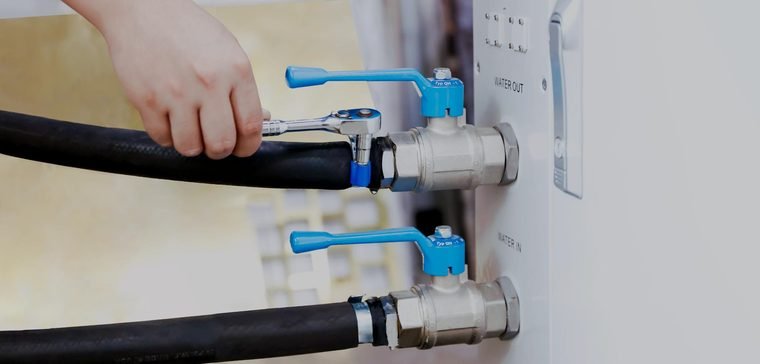
- Step 1 — Record the baseline. Write down the fluid charge, the cartridge set and the date on the tank card. Without a baseline, every later comparison is an opinion.
- Step 2 — Log the three stages separately. Which cartridge loads first tells you what your process sheds. Early stage 1 loading points at tape, labels and handling; early stage 2 loading points at paste carryover from the printer.
- Step 3 — Judge the wash result, not the fluid colour. A dark bath can still clean, and a pale bath can still leave a film. Colour is not a measurement; aperture fill and stencil underside condition are.
- Step 4 — Put the trigger on the leading indicator. Pick the first signal that moves — spray pattern, stage 2 loading, or a test-stencil result — and set the interval at the number of washes where it moves, not at the point where cleaning has already failed.
- Step 5 — Confirm rather than assume. Run a cleanliness check on test boards at the proposed interval. If the result holds, the interval is defensible; if it drifts, shorten it and note which stage moved first.
Where Filtration Staging Does Not Solve the Problem
Three limits are worth stating before anyone rebuilds a maintenance plan around cartridges.
Dissolved load is not particulate load. A 1 µm cartridge retains particles; it does not remove activator salts held in solution. A bath can look clean, pass a visual check and still carry ionic residue onto the stencil. This is why the sequence ends with a cleanliness test rather than a filter change.
Chemistry depletes on its own schedule. Surfactant and saponifier consumption, pH drift and water hardness all move independently of how fast the cartridges load. Filtration staging tells you when solids are the problem; it does not tell you when the fluid has stopped doing its job chemically.
This reasoning is not suitable for stencil wiping rolls, under-stencil paper or nozzle consumables. Those are separate consumables with their own change logic, and folding them into the bath interval hides the cost that actually moves. It is also not suitable for a line whose failure mode is machine-related rather than fluid-related — a worn spray bar or a mis-set blow-off will mimic a dead bath.
One more boundary: a larger tank is not automatically a longer interval. The CQ-C770 publishes a 50 L maximum with a 40 L optimal charge for a reason — overfilling changes how the bath behaves, and the published charge is the number to work from.
FAQ
How often should a stencil cleaning bath be changed?
There is no universal number, and any supplier who quotes one without seeing your paste, stencil count and wipe routine is guessing. Set the interval from the stage that loads first, then confirm it with a cleanliness check on test boards at the proposed interval.
Can we top up the bath instead of changing it?
Topping up replaces volume, not dissolved load. It helps with drag-out losses and it keeps the pump supplied, but it does not reset the ionic content or restore a depleted surfactant package. Treat top-up and change as two different maintenance actions with two different triggers.
What does the 0.45 µm filter on a PCBA washer do?
On the CQ-C743 it sits on the chemical recovery loop and on the DI drain, protecting the rinse side and the drain path rather than the wash bath. Its job is to keep fine paste, rosin and flux solids out of the loop that feeds a rinse published above 15 MΩ.
Does a bigger tank give a longer bath life?
Only in proportion to the extra fluid, and only if the charge is set correctly. The CQ-C770 publishes a 50 L maximum with a 40 L optimal charge; running at the maximum is not the same as running at the optimal charge, and neither changes how fast the cartridges load.
If you are trying to move from a calendar-based change to a filter-based one, send us your stencil format and current change routine and we will return a filtration and interval proposal with a quote within 24 hours. The cleaning sequence itself is covered in our stencil cleaning practice guide, and the wider maintenance calendar sits in the PCBA cleaning machine maintenance schedule.