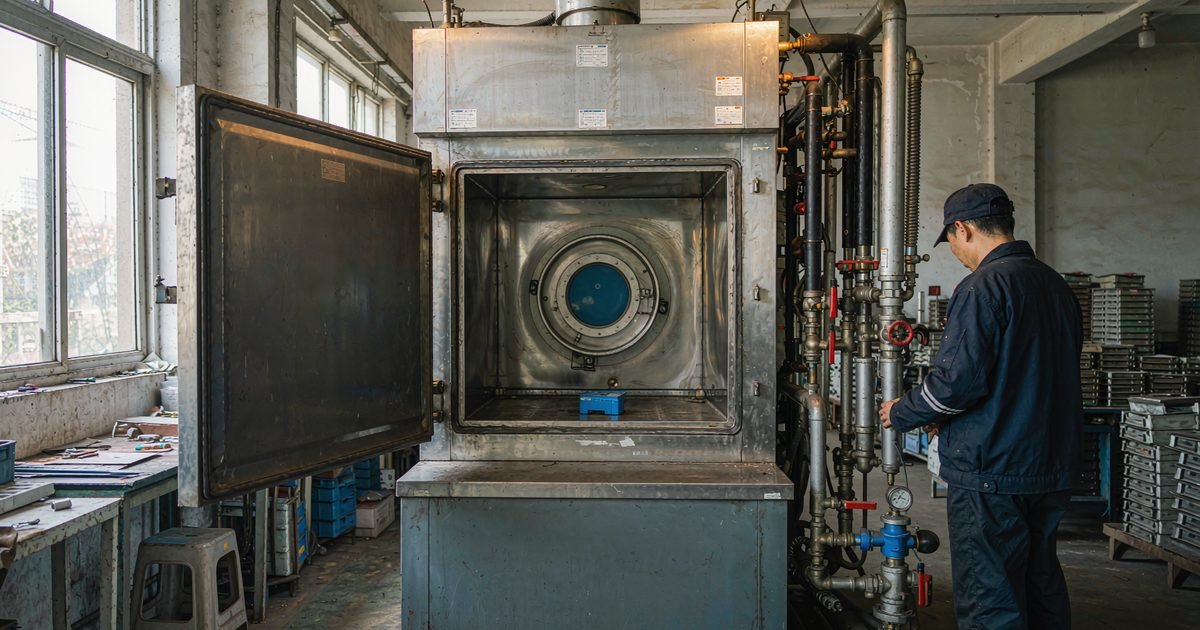
Retrofit or replace is a call most plants make by gut feeling when an aging solvent cleaning machine starts eating service hours. The better question is narrower: which utility-side variables — power supply, water quality, tank chemistry, drying — can the existing frame still carry, and which ones already disqualify it?
We checked the readable side of that question first. Across the 22 product pages we publish at chuangqitech.com, 14 pages state their rated supply voltage, 11 list connected power in kilowatts, 6 list a DI-water requirement, 8 list tank volume, and only 4 publish a filtration rating in microns. Those five fields answer most retrofit questions on our datasheets — and the audit below shows how to read them on anyone's.
Key takeaways
- Retrofit depends on utilities the frame already carries; replacement depends on chemistry the frame cannot carry.
- 14 of 22 product pages state their rated supply voltage and 11 state connected power — check those two first.
- Switching the tank chemistry changes your waste stream, pump seals and filtration plan, not just the fluid.
- No retrofit or replacement is done until it survives a 72-hour continuous factory run.
Six checks before you price either path
1. Power supply. Read the rated supply voltage the machine was built for (14 of our 22 product pages state it). An aging solvent unit wired for one market feed may still be rewireable; a controller or heater that only exists in one rating is not. If the nameplate rating does not match your feed, that single fact can end the retrofit discussion.
2. Connected power. Heaters dominate the load on a heated wash. Datasheets that publish kilowatts (11 of 22 in our audit) let you compare the machine's demand against the headroom on your distribution board. If the frame needs a second heater stage to carry a water-based recipe, the electrical side — cable, breaker, possibly the incoming feed — becomes the real project cost.
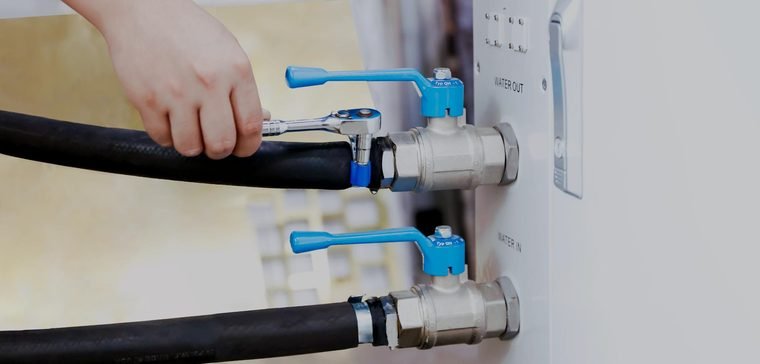
3. Water quality. A water-based recipe usually brings a DI-water dependency that the old solvent machine never had. 6 of 22 pages state such a requirement explicitly. If your plant has no DI loop, you are pricing a water treatment unit into the retrofit, and that item can exceed the cost of the conversion itself (this value depends on your feed water quality, local regulations, daily throughput and required rinse stage count).
4. Tank volume and chemistry. 8 of 22 pages publish tank volume. Volume decides dilution discipline, dump frequency and waste handling. Chemistry decides more: a solvent-to-water conversion leaves residue in the tank, seals and pumps that a rinse cannot remove. Seals and gaskets have to be compatible with the new fluid — a detail no datasheet volunteers.
5. Filtration. Only 4 of the 22 pages publish a micron rating. On the other 18, the field that decides whether the pump can hold a clean bath is simply missing — so ask, and if the answer does not come, open the filter housing and read the cartridge. Staged filtration is a common retrofit upgrade, but you cannot assume what is installed.
6. Drying. Forced-air drying is standard; vacuum drying is usually a chamber-level feature, not a bolt-on. If your boards come out with water spots after a chemistry switch, the drying section — not the wash — is often the constraint. This value depends on board geometry, component height, cycle time budget and ambient humidity.
What 22 datasheets publish — and what they hide
We audited our own product pages with a script so the numbers below are repeatable, not remembered.
| Field on the datasheet | Pages publishing it (of 22) | What it decides for a retrofit |
|---|---|---|
| Rated supply voltage | 14 | Whether the frame can be rewired to your feed at all |
| Connected power (kW) | 11 | Whether your supply has headroom for a heated water recipe |
| DI-water requirement | 6 | Whether a chemistry switch adds a new utility dependency |
| Tank volume (litres) | 8 | Dilution, dump frequency and waste-handling workload |
| Filtration rating (µm) | 4 | Silent on 18 pages — ask, then verify at the filter housing |
Source: CHUANGQI product page audit, 9 November 2026. Script-scanned across all 22 product pages; a page counts once per field if it publishes that field anywhere in its specification.
The audit's honest lesson cuts both ways. Datasheets answer the utility questions well — rated supply voltage on 14 pages, power on 11, water and tank in between. They answer the process questions poorly: filtration ratings on 4 pages, cycle time and minimum batch on none. Those gaps need a conversation, not a page.

When each path wins
Retrofit wins when the frame is structurally sound, the chamber still fits your largest pallet, the utilities above already exist in your plant, and the downtime budget is small. A filter upgrade, a seal set matched to the new fluid, a dosing pump and a concentration controller can carry a working machine several more years.
Replacement wins when the chemistry the frame was built around is disappearing from your supplier's range, when the machine has no rinse stage to speak of, or when today's boards no longer fit the chamber. Patching a machine that misses your cleanliness spec is the most expensive option of all — you pay service cost and keep the failures.
One position statement, so the advice above is not mistaken for a sales pitch: we build water-based cleaning machines, and we will tell you when an existing solvent frame is worth converting and when it is not. A wrong retrofit costs more than a right replacement, and the audit table above is the same one we start from.
Where this checklist stops
Not suitable for judging a machine you cannot inspect: if the frame has no nameplate, no wiring documentation and an unknown service history, the six checks cannot be verified, and no datasheet audit substitutes for opening the cabinet. In that case, price the replacement first and let the retrofit bid compete against it.
Also remember how any path ends. Our published factory acceptance checks water-tightness first, then spray-pressure calibration and drying-temperature uniformity, then a 72-hour continuous trial run, and finishes with ionic-cleanliness verification on test boards before dispatch. A retrofitted machine deserves the same bar — from whoever does the work.
Can any solvent cleaning machine be converted to water-based?
No. Tank material, seals, pump compatibility, DI-water supply and drying capacity all have to carry the new chemistry. The six checks above are the fast screen.
What is the first check on an old machine?
Power supply and DI water. If the frame cannot be rewired or your plant has no DI loop, both paths get more expensive immediately.
How do I verify a machine after a retrofit?
Ask for the same records a factory issues: leak testing first, spray-pressure calibration and drying checks next, a 72-hour continuous run after that, and ionic-cleanliness verification on test boards last.
What documents should a retrofit supplier provide?
Updated wiring diagrams, a parts list marked against the new fluid, filtration specification with micron ratings, and the acceptance records named above. If any of those is missing, the retrofit is not finished.
Send your machine's nameplate data — voltage, tank volume, current chemistry — plus your board sizes and cleanliness target through the cleaning machine contact form. We reply within 24 hours and say plainly whether the frame deserves a second life. For the chemistry side of the decision, see water-based vs solvent cleaning for PCBA, and for sizing a new unit from scratch, how to choose a PCBA cleaning machine. The replacement path starts at our inline PCBA water cleaning machine page.