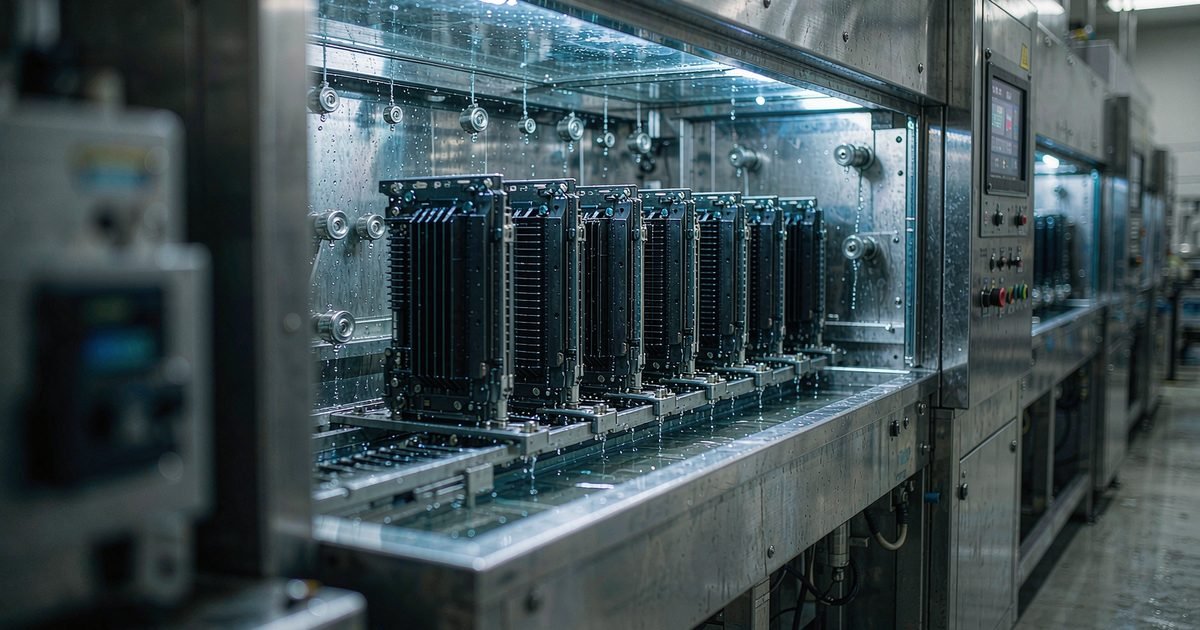
Liquid cooled server board cleaning fails differently from air-cooled cleaning: the board sits in direct coolant contact for years, and the coolant holds whatever the rinse left behind against the circuitry. The fix is sequence, not chemistry — pin down the process window first, then size the machine to it.
How big is the gap? We audited our own 22 product pages for rinse-control disclosure, and the numbers explain why buyers get burned on this step: 0 of 22 pages publish a rinse-conductivity value, 5 of 22 name DI water, deionized water or resistivity anywhere in the spec sheet, only 1 page states independent wash and rinse tanks, and 6 of 22 name a drying stage at all (Source: CHUANGQI product-page audit, 16 November 2026 — re-runnable script, table below). If rinse quality were a catalogue number, every page would list it. It is not — it is a process window you define and then verify.
Key takeaways
- Immersion turns one failed rinse into a multi-year ion reservoir.
- 0 of 22 product pages publish a rinse-conductivity figure — the window is yours to set.
- Define the four-window process first; the machine specification follows from it.
- Dry-out in the blind gaps under BGAs decides the immersion outcome.
- Batch release records belong inside the window, not in paperwork after it.
First, the scope: the residues on these boards are the same rosin, activator and solder-paste flux you already fight on any PCBA. What changes is the consequence — on an air-cooled board a marginal rinse may never matter, while on a coolant-immersed board the same marginal rinse feeds electrochemical activity for years. So “clean enough” stops being a spot-check result and becomes “no progressive activity across the service life”, which is exactly what the four windows below are for.
Process window 1: media temperature and chemical compatibility
The wash chemistry and the temperature you run it at decide how completely activators come out of dense, low-standoff packages — the same packages immersion makes hardest to service later. Two things to lock down before anyone proposes a wash recipe:
- Chemistry matched to your flux family. Water-soluble and no-clean residues do not release under the same program. Declare the flux family your line runs; a mismatch here is a common root cause behind “we cleaned it, and the field still saw failures.”
- Thermal margin on wetted parts. Long coolant contact amplifies any cleaning-agent interaction with exposed metals, so the wetted-material audit belongs in the window definition — not as a surprise after installation.
Keep this qualitative at the quoting stage. Exact bath temperature and concentration are outputs of your process qualification, and we do not publish machine-specific process parameters as if they were fixed specs.
Process window 2: rinse conductivity and final-rinse control
Rinse control is where many liquid cooled server board cleaning lines quietly lose the immersion window. The mechanism is mechanical, not mysterious: if the final rinse leaves ionic load behind, you have traded flux ions for rinse-water ions. The air-cooled board may shrug it off. The immersed board keeps those ions in the circuit’s environment for its whole life.
What the process needs is a high-purity final rinse that is monitored rather than assumed, plus a defined final-rinse isolation so the clean stage is not contaminated by wash-stage carryover. Notice what the audit says about how visible this is on spec sheets:
| Rinse-control disclosure | Pages (of 22) | What it means for you |
|---|---|---|
| Publishes a rinse-conductivity value | 0 | You must define and monitor the window yourself |
| Names DI water, deionized water or resistivity | 5 | Rinse quality is part of the spec conversation, per model |
| States independent wash and rinse tanks | 1 | Stage separation is design-dependent — ask per machine |
| Names a drying stage | 6 | Dry-out completeness needs process verification, not a spec line |
(Source: CHUANGQI product-page audit, 16 November 2026. Scan covers all 22 product pages on chuangqitech.com; re-runnable with the audit script. The single page stating independent wash and rinse tanks is a dual-frame stencil cleaner; no board-washer page states it in those words.)
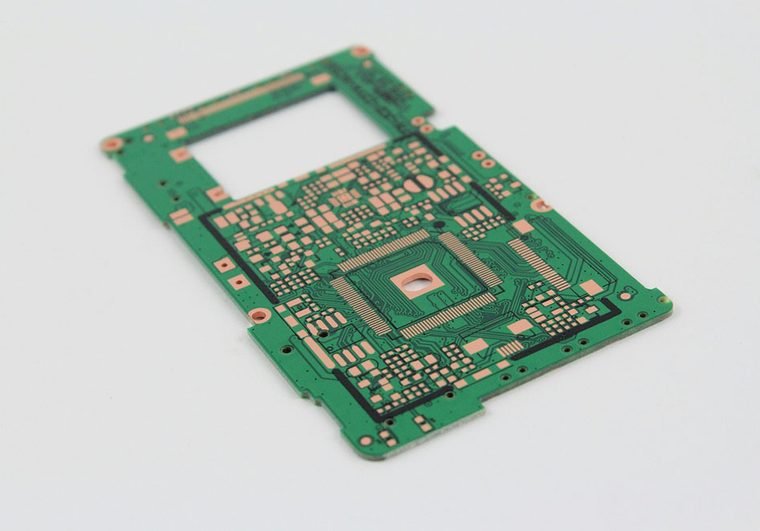
You do not need to borrow a single universal conductivity limit — none exists that covers every board design. You need a monitored, documented final-rinse state you can reproduce batch to batch. For how to derive an internal threshold from evidence rather than a borrowed number — SIR (surface insulation resistance) testing, historical field data or your customer’s spec — see setting your ionic contamination test frequency.
Process window 3: dry-out in the dead corners
Dense server boards hide blind gaps under large ball-grid-array (BGA) packages, connectors and power modules. A wash that looks complete on the surface can park a thin film or a trapped droplet in one of those corners — and under immersion that pocket becomes a localized electrolyte reservoir. If you have ever held a board under the inspection light and wondered about the shadow under a connector shell, that shadow is the whole window.
The window is drying completeness and board presentation, not “did it look dry”. Specify how the board meets the dryer — orientation, spacing, shielded zones — and require that dryness is verified in the low-clearance zones and not merely on the exposed topside. This is the step most often skipped when the line is bought as general-purpose capacity, and the one with the highest immersion consequence; it is also why a generic “we clean PCBA” answer is not enough for server boards.
Process window 4: batch release records, not afterthoughts
For immersion-bound boards, cleaning is a qualified process, not a one-off operation. The release record — bath condition, rinse trend, dryness check, board presentation — is the evidence that this batch ran inside the same window as the qualified sample. Build the requirement into the process specification up front:
- Define what gets logged per batch and how each entry maps to a board lot.
- Define how long records are retained and who can call them up.
- Treat drift in any of the four windows as a requalification trigger, not a cosmetic alert.
That evidence chain is what turns “we washed it” into “we can prove this board ran inside the immersion window”. If you are building the record format, the six records that turn “washed” into “released” gives you the field list. Buyers qualifying a supplier should ask for a sample release record, not just a brochure.
How this maps to a washer specification
Once the four windows are defined, the machine question becomes narrow: can the proposed inline or batch washer control and record media temperature, final-rinse conductivity, dry-out in dead corners, and per-batch release data? For the pre-quote checks that sit one layer above this guide — fluid contact, the leakage-current signature and six inspection points — read Liquid-Cooled Server Boards Rewrite the Cleanliness Spec.
If your line runs high-mix server and standard PCBA together, an inline water-cleaning platform whose wash and final-rinse stages your process team can qualify against these windows is the starting point: send your window requirements — a machine recommendation follows, with a quote within 24 hours.
FAQ
Do server boards need a harsher wash than standard PCBA?
No — a different one. The residues are the same; the consequence of a marginal rinse changes because coolant keeps whatever remains in contact with the circuitry for years. That shifts the goal from passing a spot check to holding a stable process window across the service life.
Is there one conductivity number that proves the rinse is clean?
No. No single limit covers every board design, and none of the 22 product pages we audited publishes one. Derive an internal threshold from your own evidence — SIR testing, historical field data or your customer’s spec — and monitor against it batch to batch.
Inline or batch washer for liquid-cooled server boards?
Volume decides. High-mix lines that also run standard PCBA usually justify an inline platform with separated wash and final-rinse stages and continuous monitoring; low-volume qualification runs can start in a batch machine. The windows above apply to both — what changes is how the records are produced.
What should a per-batch release record contain?
At minimum: the batch identifier and board-lot mapping, the rinse condition observed during the run, the dryness check result, and the sign-off that the batch ran inside the qualified window. Keep the format identical to the one your customer’s audit will ask for — see the release-records guide for the full field list.