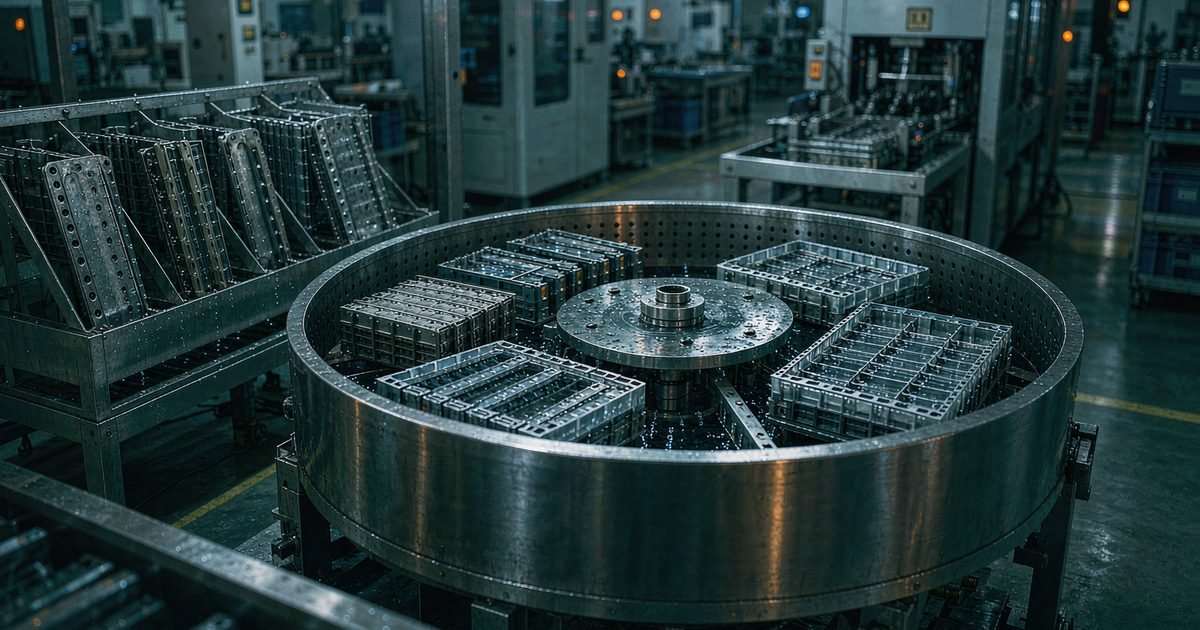
Tray and carrier cleaning is where an SMT plant can lose the cleanliness it has just paid for. Carriers touch the board after the wash, so paste, red glue, flux and dust on a nest are re-deposited on a cleaned assembly, and the step deserves its own specification.
CHUANGQI builds the batch side of that step as the CQ-C756 fixture and pallet cleaning machine: a spray-in-basket washer with a 1,000 mm basket diameter, a 480 mm maximum workpiece height, a 100 kg basket load, spray pressure published at 3–6 bar inside a 3–8 bar range, a 60 L tank and hot-air drying up to 99 °C (a machine ceiling, not a rating every carrier material shares). Before shipment, each unit goes through water-tightness and spray-pressure calibration, runs continuously for 72 hours, and finishes with an ionic cleanliness check on sample boards.
Key takeaways
- Carriers re-deposit paste, adhesive and dust onto boards by direct contact.
- Four checks decide whether tray cleaning earns its own process step.
- The CQ-C756 basket takes workpieces up to 480 mm tall on a 1,000 mm diameter.
- Turnover stock sets the interval you can run, not the wash cycle alone.
Four Checks Before You Quote a Carrier Washer
Work through them in order. Each one can end the project, and the expensive mistake is running them backwards — buying a machine first and discovering at commissioning that the carriers never touched a board after cleaning anyway.
Check 1 — Map the contact path. Trace every point where a carrier touches a board after the cleaning step: nests, edge supports, vacuum pads, clamp faces. Count them per carrier and note which ones face the solder side. If the answer is zero, the case for a dedicated washer is weak. If the answer is a dozen points per carrier across a full shift, the board is being cleaned and then handled by a dirty fixture.
Check 2 — Compare turnover stock with the cleaning interval. Cleaning consumes time in the carrier loop, so the loop needs enough carriers to keep the line fed while a batch is in the machine. Take the number of carriers in circulation, divide by the number the basket holds, and compare that with the interval the contamination actually demands. A washer that cleans well but cannot keep up simply moves the bottleneck to the carrier store.
Check 3 — Decide batch or in-line. A batch basket suits mixed carrier types, low and medium volume, and any plant where carriers arrive back at irregular times. An in-line stage suits a single carrier family moving at line pace. Choosing batch for a line-paced flow adds handling; choosing in-line for mixed tooling adds changeover.
Check 4 — Screen materials and static control before specifying heat. Aluminium pallets, static-dissipative trays and machined jigs behave differently in a hot-air dry. Read the tray’s own temperature rating first: the machine’s 99 °C upper limit is not a target, and a carrier material rated below the dry setpoint will distort before the board ever reaches it.
What the Published Machine Limits Mean in Practice
Published limits are most useful as exclusions. Each figure below removes a category of workpiece from the conversation before a quotation is written.
- Basket diameter 1,000 mm — the constraint is the diagonal, not the length: a carrier longer than the basket chord has to be loaded at an angle or split into a smaller format.
- Maximum workpiece height 480 mm — tall magazine-style fixtures and stacked carriers exceed this before any basket loading question arises.
- Basket load 100 kg — a basket full of steel carriers reaches this limit faster than a basket of aluminium ones, so weigh a representative batch, not one carrier.
- Spray pressure 3–6 bar (range 3–8 bar) — pressure is a setting on the machine, and the useful number is the one that clears paste from nests without moving thin sheet-metal parts.
- Tank 60 L — charge volume sets how much contamination the bath can absorb before a change, and it sets the floor area the machine needs with its 0.1–0.3 MPa water supply.
- Dry up to 99 °C — the upper limit protects drying time, not every material; the carrier rating decides what you can actually set.
| Published limit | Value | What it excludes |
|---|---|---|
| Basket diameter | 1,000 mm | Carriers whose diagonal exceeds the basket chord |
| Max workpiece height | 480 mm | Tall magazines and stacked fixtures |
| Basket load | 100 kg | Bulk batches of dense steel carriers |
| Spray pressure | 3–6 bar (range 3–8 bar) | Delicate parts that cannot take the spray |
| Tank capacity | 60 L | Continuous high-volume flow needing constant refresh |
| Drying temperature | Up to 99 °C | Carrier materials rated below the setpoint |
Source: CHUANGQI published product specifications (CQ-C756). Figures are machine limits, not production recommendations.
Where a Batch Carrier Washer Is the Wrong Choice
The four checks above are written to disqualify projects as often as they qualify them, so the boundaries deserve their own section.
Not suitable for a line-paced flow with a single carrier family. If carriers return at a fixed cadence and one format dominates, a batch basket adds a handling step and a store. That case belongs to an in-line stage, not to a round basket.
Not suitable for replacing board-level cleaning. Cleaning a carrier removes what the carrier would have transferred; it does not remove flux residue from under a component on the assembly. Those are two processes, and a plant that buys the first to solve the second will still fail its cleanliness check.
Not suitable where the carrier is the product. Precision machined fixtures with lapped faces or bonded inserts can be damaged by basket handling before spray pressure becomes relevant. Those parts need a fixtured process, not a tumbling basket.
Not suitable as a single-number decision. A quotation built only on basket size ignores tank volume, dry setpoint, water supply and compressed air at 0.4–0.6 MPa. All four determine whether the machine fits the bay it is going into.

FAQ
How often should SMT carriers be cleaned?
The interval should follow contamination, not the calendar. Inspect nests and clamp faces for paste and adhesive build-up at a fixed carrier count, then set the cleaning interval one step earlier than the point where build-up appears. Carriers in a reflow-adjacent loop usually load faster than carriers used only for handling.
Can one washer clean both boards and carriers?
Physically it can, and process-wise it is a poor idea. Boards carry ionic residue that needs a rinse and a cleanliness verification; carriers carry paste, adhesive and dust that need mechanical removal. Mixing them puts board residue into the carrier bath and carrier debris onto board surfaces.
What carrier sizes fit a 1,000 mm basket?
It depends on the diagonal, because a round basket accepts a rectangular carrier only up to the chord it can pass. Measure the longest diagonal of the largest carrier, not its length, and allow for the height limit of 480 mm and the 100 kg basket load.
How do we prove carriers are clean before they touch a board?
Agree a check with the customer and run it on a carrier that has been through the real loop: a wipe test on nest faces, a visual standard for paste and adhesive, or ionic verification on a test board handled by the carrier. The check has to be repeatable by shift staff, otherwise it will be skipped.
If you are writing carrier cleaning into a specification, send us your carrier drawings and turnover volume and we will confirm the basket fit and send a quote within 24 hours. The reflow-side equivalent is covered in our wave-solder pallet cleaning guide, and the way to test a cleaning result before committing to a machine is set out in sample cleaning tests before you buy.