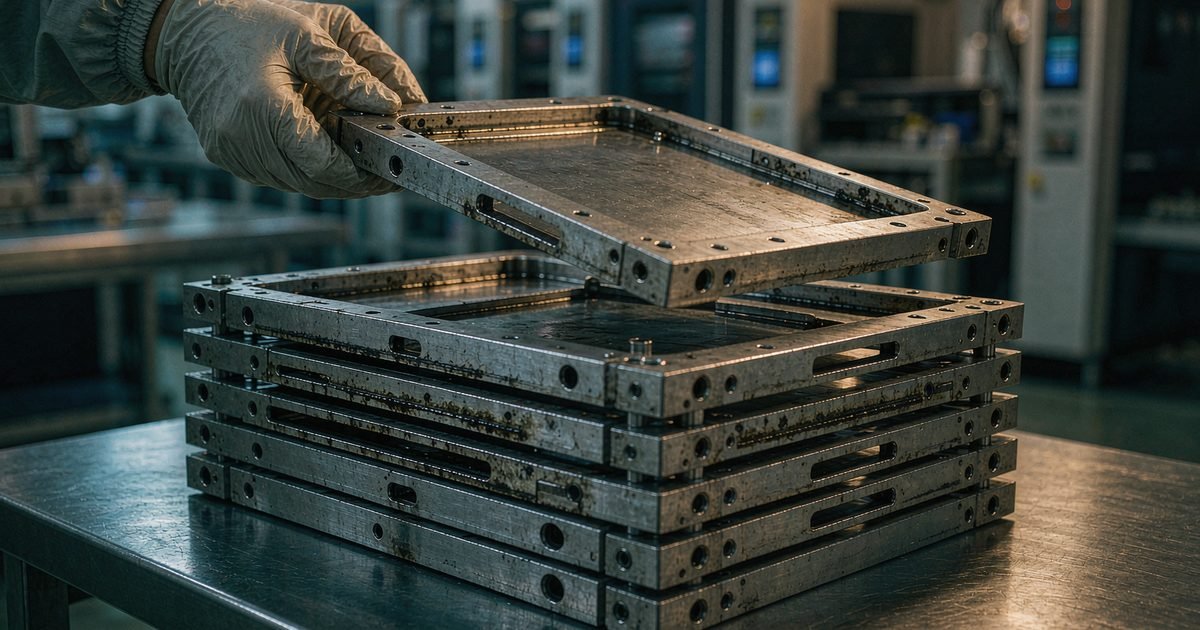
A wave solder pallet is a machined carrier that holds a printed circuit board through wave or selective soldering. It shields areas you do not want soldered and absorbs flux, dross and heat. Solder pallet cleaning keeps that carrier from feeding contamination back onto the board.
Most EMS teams treat pallets as tooling rather than a controlled process. That is the root of the problem.
What Actually Builds Up on a Solder Pallet
The residue on a pallet is not one substance. It is a stack, and the layers behave differently.
Flux solids. Activated flux that reaches the pallet surface and is never reflowed stays tacky, then bakes on through repeated thermal cycles. These solids are the reason a pallet that “looks clean” still fails an ionic contamination check.
Solder dross and micro-spheres. Every wave produces dross. Some of it lands on the pallet edge and on the cut-outs, where it sticks to flux residue and forms a hard, dark crust.
Carbonised flux. After enough cycles the tacky layer turns into a baked-on film. This film is what makes the pallet start to smell during preheat, and it is what manual wiping fails to remove.
Pallet coating debris. Laminates, anodised aluminium and coated steel pallets all shed a little material at the cut-out edges over time. Cleaning that is aggressive enough to remove carbonised flux can also be aggressive enough to attack the coating.
Pallet magnets and inserts. The magnets that hold the pallet to the conveyor are the part everyone forgets. They collect ferrous particles, and those particles attract more flux.
Here is why the stack matters: each layer needs a different removal mechanism. Hand wiping with a solvent removes the tacky top layer and leaves the carbonised layer under it. The pallet looks acceptable, goes back on the line, and then releases that baked layer as airborne particulate during the next preheat.
Everyday Signs Your Pallet Cleaning Step Is Failing
- Solder defects cluster on boards that ran on one specific pallet, not on the whole line.
- Pallet surfaces feel smooth but the underside of the board shows a dark smear after wave.
- The pallet set begins to smell when it enters the preheat zone.
- Operators start wiping pallets at the machine, which is a sign that the scheduled cleaning has already failed.
Cleaning Options Compared: Manual, Ultrasonic, Spray, Inline
Four options are actually deployed in production. They are not interchangeable, and the trade-offs are about throughput, repeatability and coating compatibility rather than about “clean versus dirty”.
| Method | How it works | Best fit | Main limitation |
|---|---|---|---|
| Manual wipe / brush | Solvent or detergent applied by hand, agitation by operator | Emergency touch-ups, very low pallet counts | Result depends on the operator; carbonised layer survives; solvent exposure |
| Ultrasonic bath | Cavitation removes residue from blind holes, magnets and inserts | Complex fixtures with magnets, small batches | Batch only; parts must be racked so cavitation reaches the surface |
| Spray / jet cleaning in a batch chamber | Rotating or fixed nozzles with heated detergent | Mixed pallet sizes in one load, medium volume | Load configuration matters; heavy carbonised films may need a repeat cycle |
| Inline cleaning | Pallet passes a conveyorised wash, rinse and dry sequence | High-volume lines where pallets circulate continuously | Justified only above a certain pallet turnover; floor space commitment |
The selection question is not “which machine is best”. It is “which mechanism reaches the layers we actually have”.
If the residue is mostly fresh flux, a heated aqueous detergent in a batch chamber is sufficient. If the pallets carry magnets, inserts and blind holes, you need a mechanism that works without line of sight. That is cavitation, or a spray pattern designed to reach into the same geometry. If the baked layer is already established, the first job is to break that layer; the method that does it well is agitation plus temperature plus the correct detergent chemistry, held long enough to work.
Two practical constraints decide most projects:
1. Deterministic results. A process that depends on a human scrub has no capability index. If your customer audits the soldering process, the pallet cleaning step has to be documented as a process with parameters, not as an instruction to “clean as needed”. 2. Compatibility. Laminates, anodising, coated steel and magnets all react to temperature and chemistry. Always check the pallet manufacturer and the detergent supplier for compatibility before setting temperature and concentration.
For the board itself, the same logic is covered in our guide to mixed-technology PCBA cleaning strategy; pallets and boards are two different cleaning problems that share a line.
How to Set Up a Pallet Cleaning Routine
Treat the pallet fleet as a controlled asset with its own documents. The following sequence is the one that survives audits.
Step 1 — Inventory and tag. Give every pallet an ID. Record material, coating, magnet type and the part numbers it runs. Without this you cannot tell a failing pallet from a failing process.
Step 2 — Define the cleaning trigger. Do not use calendar time alone. Set the trigger on accumulated thermal cycles, and add a visual acceptance check at the machine. Typical triggers are a fixed number of passes, a visible film at the cut-out edges, or a defect cluster in final inspection.
Step 3 — Classify the residue. Ask the flux supplier to identify the flux chemistry used on that line, and check how that chemistry responds to aqueous detergent versus solvent. This is the single decision that most pallet cleaning projects get wrong.
Step 4 — Write the process parameters. Temperature, detergent concentration, agitation time and drying conditions all belong in a written procedure. Keep them inside the ranges the pallet and detergent suppliers allow.
Step 5 — Qualify the result. Define what “clean” means for a pallet in your plant. Many teams use a combination of visual inspection at the cut-outs and a periodic ionic contamination check on the pallet surface, with the acceptance criteria set against the product reliability class, following IPC’s published guidance.
Step 6 — Close the loop. Link pallet IDs to soldering defects. When a defect cluster appears, check whether it tracks to one pallet before you change the soldering profile.
Step 7 — Plan storage. Contamination returns fast on a pallet that is stored open in the soldering area. Covered, segregated storage buys back part of the cleaning interval.
Equipment note
The CHUANGQI Fixture & Pallet Cleaning Machine (CQ-C756) is built for this task specifically: wave solder pallets and selective soldering fixtures, with a load configuration intended for mixed fixture sizes. Confirm the tolerance ranges with the pallet manufacturer before you set temperature and chemistry, and check the cleaning applications we cover if your pallets share a line with other tooling.
We quote for the pallet sizes and mix you actually run rather than for a generic figure. Send the pallet drawing and the flux chemistry through the fixture cleaning RFQ form and a quote comes back within 24 hours.
Pallet Cleaning Questions Engineers Actually Ask
Can we just scrub the pallets with IPA by hand?
For fresh flux, hand wiping removes enough to get through the shift. It does not remove carbonised flux, it does not reach magnets and blind holes, and the result varies by operator. Use it as an interim measure, not as the process.
How often should pallets be cleaned?
Set the interval from accumulated thermal cycles plus a visual acceptance check at the machine, not from the calendar. The correct interval is the longest one at which the pallet still passes your acceptance check; verify it, then document it.
Will cleaning damage the pallet coating or the magnets?
It can, if temperature and chemistry are chosen without checking compatibility. Confirm the allowed ranges with the pallet manufacturer and the detergent supplier, and keep the process inside them. Magnet assemblies are usually the first component to show damage.
Do we need a separate machine for pallets and stencils?
Pallets and stencils are different geometries with different residues, so a machine tuned for one is usually a compromise for the other. Where floor space allows, dedicated equipment gives a more predictable result. Where it does not, agree the load configuration and the parameters with the supplier so both part types have a qualified procedure.
What information do we need to send to get a quote?
Pallet dimensions and weight, pallet material and coating, magnet and insert positions, the flux chemistry in use, how many pallets you run per shift, and your target cleaning interval. With those, we can size the machine and respond with a quote within 24 hours.
If you want a recommendation sized to your pallet mix, send us the pallet drawing and flux chemistry and we will come back with a machine recommendation and a quote within 24 hours.