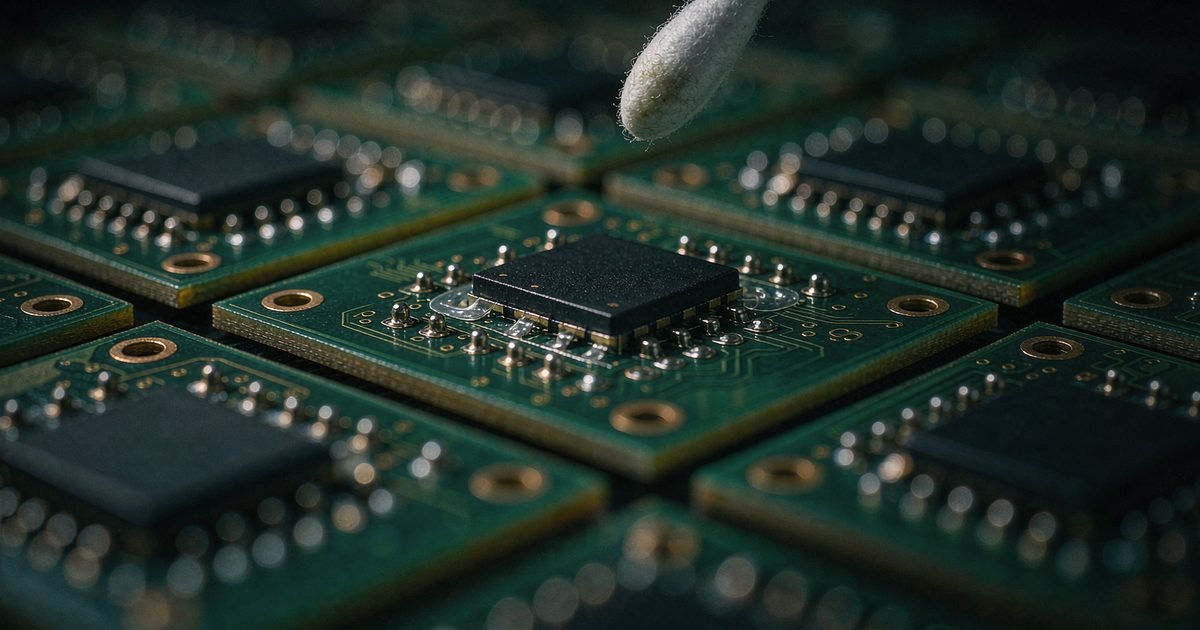
No-clean flux is not a promise that the board needs no cleaning. It is a claim about how much residue the chemistry leaves behind and how benign that residue is under a defined set of conditions. Change those conditions — a higher reliability class, a conformal coating step, a humid end environment — and the same flux stops being “no-clean” in practice.
The useful question is therefore not “is no-clean flux clean?” but “under which conditions does this board still have to be washed?” This article gives you a four-part framework to answer that for your own product, without pretending there is one universal rule that covers every assembly.
Key takeaways
- “No-clean” describes a flux chemistry under conditions, not a board that never needs washing.
- Four conditions flip the decision: reliability class, coating, environment and geometry.
- IPC no longer sets a single ionic limit; acceptance runs through three agreed routes.
- Document the call before production — an undocumented decision cannot survive an audit.
What “No-Clean” Actually Means
This article sets out a judgment framework for boards soldered with no-clean chemistry. It explains how to decide whether a wash step is required, not how to run a specific machine — cycle parameters belong to your process, not to a general guide.
Definition. No-clean flux is formulated so that its residue, left on the assembly, is intended to be electrically benign — low enough in ionic activity and adequately encapsulated that it does not need removal for the product to function as designed.
Why it matters. That intention is conditional. The flux supplier validates “no-clean” against assumptions about the soldering profile, the cleanliness of the process, and the reliability the product has to meet. Your board inherits none of those assumptions automatically; it has to satisfy them.
Actionable step. Before deciding, write down the four conditions from the next section for your specific product. Where the framework says the assumptions break, the answer is a wash step — not a debate about whether the flux was labelled no-clean.
One point on standards, because it is routinely misread. IPC’s published guidance on cleanliness acceptance no longer fixes a single universal ionic contamination limit; the old benchmark was removed and acceptance is now established per product along three permitted paths — surface insulation resistance testing, service history without any residue-driven failures, or humidity-bias testing. So “no-clean” cannot be validated by quoting a number. It has to be validated against the criterion you agreed for that product.
Four Conditions That Flip the Decision
The decision is not a property of the flux. It is the outcome of four conditions, and any one of them can move a board from “no wash required” to “wash required”.
| Condition | No-clean holds when… | The decision flips to washing when… |
|---|---|---|
| Reliability class | The product tolerates residue because its end use is benign and short-lived | The product carries a high-reliability requirement where residue-driven failure is unacceptable |
| Downstream process | Nothing is applied over the board after soldering | Conformal coating or potting follows, sealing residue against the surface |
| End environment | The assembly lives dry and stable | Humidity, condensation or thermal cycling can mobilise ionic residue |
| Board geometry | Open layouts where residue sits on visible, accessible surfaces | Low-standoff parts and fine-pitch areas where residue collects out of reach |
Source: CHUANGQI application notes, 2026-10; acceptance-routes framing per IPC’s published guidance on cleanliness acceptance.
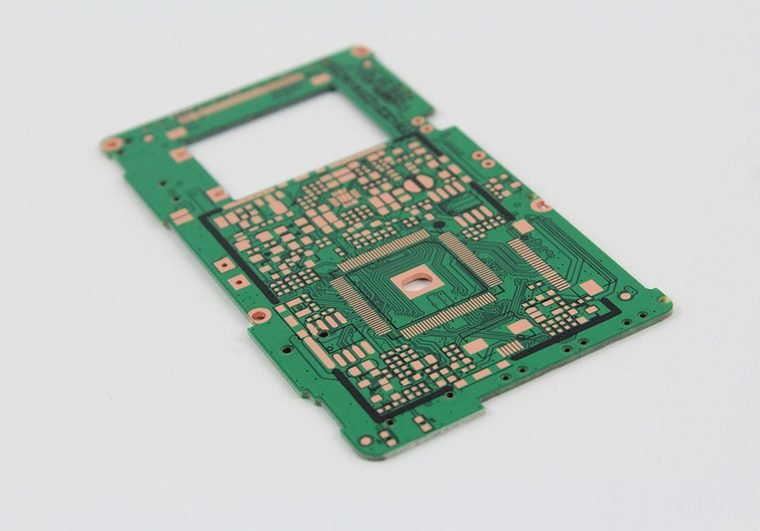
Read the table as a set of switches, not a scorecard. A single row flipping to the right can be enough on its own. A board that is low-reliability, uncoated and dry can tolerate no-clean residue that would be unacceptable on the identical board once a conformal coating is added — because the coating turns scattered residue into a sealed electrolyte layer sitting directly against the surface.
How to Judge Before the Board Fails
The judgment is worth making on a desk, not in a failure analysis lab. Work through the four conditions with the people who own the process, and record the outcome.
- Name the reliability class in writing. If the product is bound for a regulated or safety-relevant use, treat the default as “wash required” and let evidence argue it down, not up.
- Check what happens after soldering. Coating, potting or lamination all sit on top of whatever residue is present; if any of them follows, resolve the residue first.
- Look at where the residue lands. Residue under a low-standoff package is not the same risk as residue on an open test pad. Geometry decides whether a wash can reach the problem at all.
- Decide the verification route up front. Pick one of the three accepted paths — SIR testing, field history or bias testing — and agree it with your customer before production, not after a complaint.
Where the framework simplifies is worth stating honestly. On an open, dry, uncoated, low-reliability board, a defensible decision can simply be “no wash, periodically checked” — and forcing a water-based process onto that board adds cost and handling for no reliability gain. The framework earns its keep when the product is coated, regulated, or destined for a humid environment. It is a filter for those cases, not an argument that every no-clean board must be washed.
Two background pieces help while you work through it. If the criterion itself is still open, setting a cleanliness acceptance line for a PCBA explains how those lines get set per product. If residue has already caused a problem in the field, flux residue cleaning after soldering covers what a wash actually removes. Where the framework points to a wash step, the inline PCBA water cleaning machine is the wash–rinse–dry configuration that keeps the result repeatable.
Frequently asked questions
Is no-clean flux really no-clean?
It is “no-clean under conditions”. The chemistry is formulated so that its residue is intended to be benign for a defined reliability envelope. Step outside that envelope — a coating step, a humid end use, a tighter reliability class — and the residue has to be removed. The label describes the flux, not your board.
When does a no-clean board have to be washed?
When at least one of the four conditions breaks: a high-reliability requirement, a coating or potting step after soldering, a humid or condensing end environment, or geometry that hides residue under low-standoff parts. Any one of these is enough. The safest pattern is to decide which apply before production and document the call.
Does conformal coating change the answer?
Yes, and it is the most common trigger. A coating applied over residue seals that residue against the surface rather than removing the risk. Where coating is part of the process, treat the pre-coating clean as mandatory and verify it against the criterion agreed for the product, rather than relying on the flux being labelled no-clean.
How do we document the decision?
Write down the four conditions for the product, the verification route you agreed with your customer, and who signed release. That record is what lets you explain the decision during an audit, and what tells you when to revisit it — a new coating step, a new flux or a change in end environment should reopen the question.
Next step: send your flux chemistry, board geometry and the reliability class you are building to, and the CHUANGQI team will help you judge whether the no-clean route still holds for your product — start a process assessment.