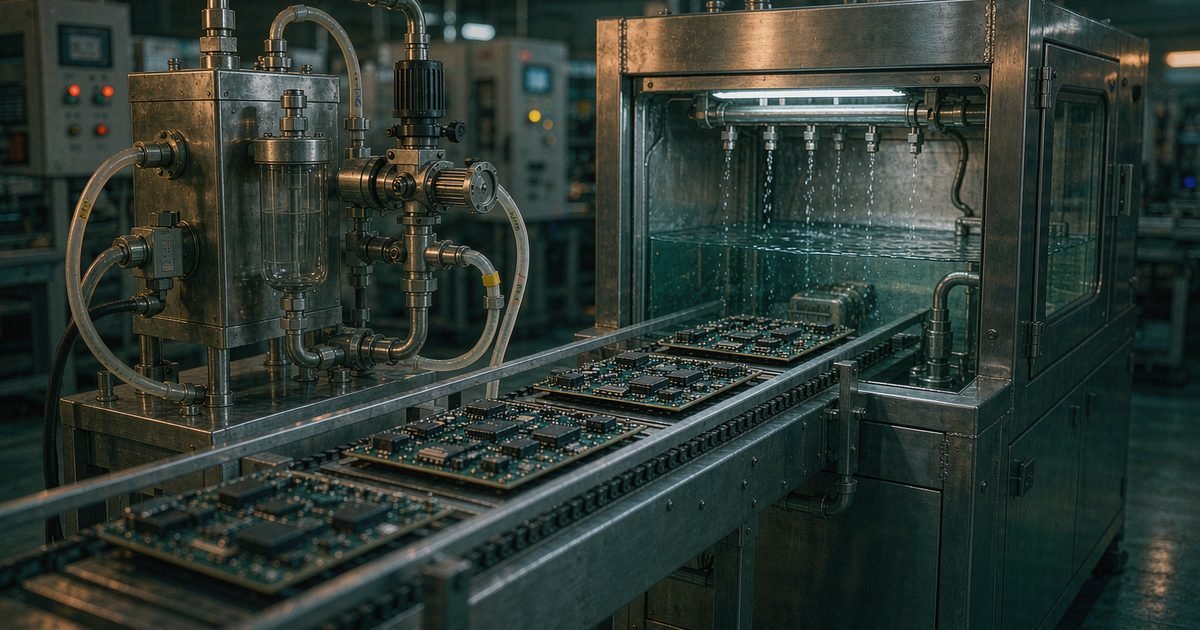
Switching the water-based cleaning fluid on a PCBA washer looks like a purchasing decision and behaves like a process change. The six checks below tell you whether a new water based cleaning fluid does the same job as the one it replaces, before you release production behind it.
The sequence is not invented for this article. It follows the acceptance routine CHUANGQI runs on every machine before shipment: a 72-hour endurance run, ionic-cleanliness checks on test boards, hot-air temperature uniformity measurements, and calibration of both spray pressure and enclosure water-tightness. Replace the machine with your own line and the same sequence answers the fluid question.
Key takeaways
- A fluid swap moves bath chemistry, rinse load and dry performance — rarely all three equally.
- Every CHUANGQI machine passes a 72-hour endurance run and ionic verification before shipment.
- Inline washer CQ-C9610 documents a 1.0–2.5 L/h detergent band and a 10–16 L/min DI draw.
- Solvent machines, dry-ice blasting and non-aqueous processes sit outside this protocol.
What a Fluid Change Actually Changes
Method and scope. This protocol covers post-solder cleaning of assembled boards in water-based conveyor and batch washers, where a detergent is dosed into a wash stage and carried into a deionized (DI) water rinse. Every value quoted below is a documented machine range taken from published CHUANGQI specification data, not a recommended production setting. No external numeric claims are used.
The cleaning fluid is not a drop-in consumable, because the machine treats it as three connected loads:
- Bath chemistry. A different detergent or a different concentration changes how much flux the wash stage holds in solution before the bath starts returning residue to the board. The measurable side of this is detergent consumption per hour and the concentration you maintain.
- Rinse load. Everything the wash releases has to be carried out of the rinse, and the rinse has a finite capacity set by water quality and flow. A fluid that cleans aggressively can leave the rinse stage doing more work than it did before.
- Dry performance. Detergents differ in what they leave behind after the rinse, and residues that later attract moisture are judged at the dry stage. This is why a drying temperature uniformity test exists in the acceptance routine at all.
Because the three loads interact, a fluid change that only moves one of them usually looks fine for a week and then shows up as an exit problem.
The Six Requalification Checks
Run these in order on the first batch after the change. Each one produces a record rather than an opinion.
Check 1 — Confirm the wash stage is delivering, not just dosing. Before judging the fluid, verify that the pump and spray bars are doing what they did with the old chemistry. The pre-shipment routine calibrates spray pressure for exactly this reason, and a baseline figure from your own commissioning record is the comparison that matters. This reading depends on nozzle condition, filter loading, pump output and the detergent concentration in the tank — not on the fluid alone.
Check 2 — Record detergent consumption per hour. Published documentation for the conveyor machine CQ-C9610 sets its detergent band at 1.0–2.5 L/h while running. If the new fluid sits at the top of that band at the same board mix, your bath is working harder for the same cleaning result, and the cost per cleaned assembly has moved. The figure depends on soil loading on the boards, the target concentration, the drag-out from the wash into the rinse, and the belt speed setting.
Check 3 — Watch the rinse, not the wash. The rinse stage removes the ionic content the wash released plus the fluid itself. On CQ-C9610 the DI rinse is rated above 15 MΩ; while the line runs, the stage draws 10–16 L/min of DI water and the feed line supplies 1.0 m³/h. Read resistivity at the tank outlet: if it stops holding after a fluid change, the new chemistry is loading the rinse beyond its previous duty. The value depends on incoming water quality, the drag-out carried on the board, the board’s surface area and the number of rinse stages.
Check 4 — Inspect the filtration side. The batch counterpart CQ-C743 documents 0.45 µm filtration on both the chemical-recovery line and the DI drain line. Filtration media that loads faster after a change is telling you the new fluid is holding different material in suspension — useful information, and the earliest warning that bath life is shortening. The interval depends on the soil type, the bath temperature, the amount of board area cleaned per shift and the filtration surface available.
Check 5 — Judge the exit, not the wet board. Drying is where fluid changes are usually blamed and rarely verified. CQ-C743 reaches up to 99 °C in the dry stage; on a conveyor machine, the work is done by the length of the dry zone and by the arrangement of the air knives. Compare exit dryness on the first batch against your normal board, with the same belt speed. The result depends on belt speed through the dry zone, the thermal mass of the assembly, plant humidity and component geometry that traps water.
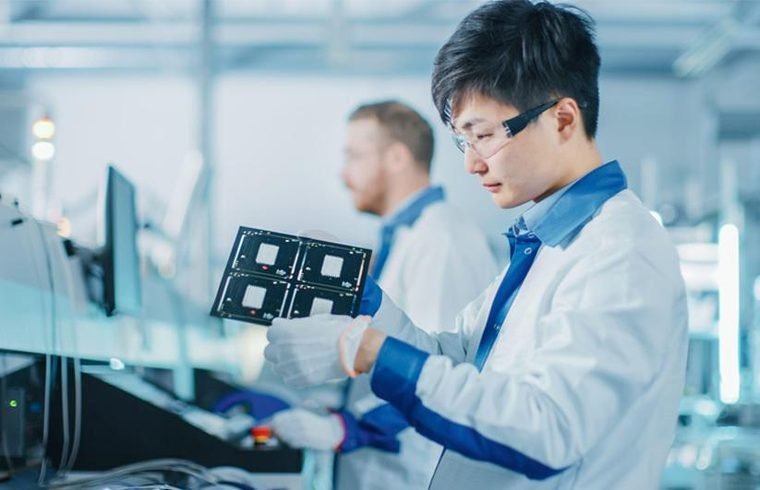
Check 6 — Verify cleanliness the way the machine itself is verified. The acceptance routine ends with ionic cleanliness verification on test boards, and it is the check that separates a successful fluid change from a plausible one. Run the same verification you use for incoming quality, on coupons that travelled with the first production batch.
A Trial Sheet: What to Record and Where the Values Come From
The point of recording these columns is that a fluid change becomes a document you can show a customer auditor, rather than a decision someone remembers making.
| Check | Documented reference (source) | How to read it |
|---|---|---|
| Spray delivery | Spray pressure 30–40 psi (CQ-C743) | Compare with your commissioning baseline, not the band |
| Detergent demand | Documented band 1.0–2.5 L/h (CQ-C9610) | Drift upward at the same board mix means higher cost per board |
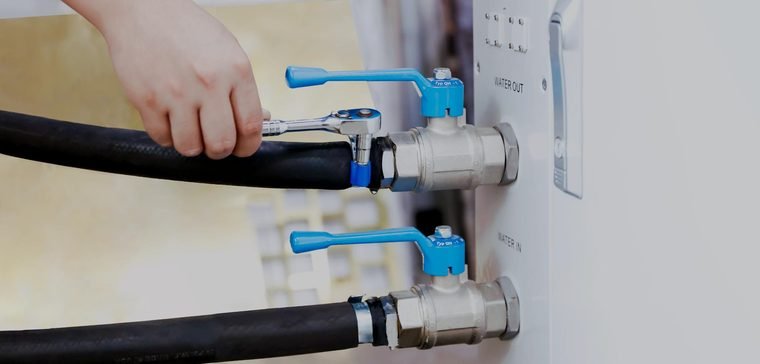
| Rinse quality | >15 MΩ rated; 10–16 L/min draw; 1.0 m³/h feed (CQ-C9610) | Read at the tank outlet while the line runs |
| Filtration load | 0.45 µm recovery and drain filtration (CQ-C743) | Shortened change interval signals a shorter bath life |
| Dry performance | Up to 99 °C dry stage (CQ-C743) | Compare exit dryness at the same belt speed |
| Cleanliness | Ionic cleanliness verification on test boards (CHUANGQI pre-shipment routine) | Coupons that travelled with the first production batch |
Source: CHUANGQI published machine specifications and the pre-shipment acceptance routine. Ranges are documented machine limits, not recommended process settings.
A trial sheet also needs the fixed conditions written down, because a requalification is not repeatable without them: board construction (a double-sided FR-4 assembly with mixed surface-mount and through-hole joints), residue type (rosin, mildly activated flux), cleaning agent (the new water-based fluid at its specified concentration), cycle setting (the belt speed used for that board), and acceptance criteria (ionic cleanliness verification plus visual residue inspection plus dry exit). Write the conditions before the trial, not after it.
Where This Protocol Does Not Apply
The six checks assume an aqueous process with a dosed detergent and a DI rinse. They are not suitable for solvent machines, where bath chemistry is managed by distillation and inhibitor levels rather than by detergent concentration, and they do not transfer to dry-ice blasting or other non-aqueous surface preparation, where there is no bath to requalify at all. They also do not replace your own customer acceptance requirement: if a customer specification names a verification method, that method governs, whatever this sheet says.
One further limit belongs in the record. A requalification trial run on one board mix does not qualify the fluid for every product you clean. If your plant runs several flux chemistries, the trial sheet has to be repeated for each family, and that repetition is the honest cost of a fluid change.
FAQ
Does a new cleaning fluid brand need requalification if the chemistry looks the same?
Yes. Two fluids described with the same chemistry family can still differ in concentration, surfactant package and what they leave after rinsing, and the rinse and dry stages are where those differences surface. The checks above are cheap; a released batch that fails ionic verification is not.
How long does a fluid requalification trial take?
Long enough to cover one full production batch plus the cleanliness verification. The measurement side is fast — consumption and rinse readings come off the machine while it runs — but the verification step depends on your own laboratory turnaround, so plan the change around your incoming-quality schedule rather than around a shift change.
Do I need to requalify if only the supplier changes but the formulation does not?
Treat a supplier change as a fluid change until the supplier confirms in writing that the formulation and concentration band are unchanged. Once that confirmation exists, a shortened version of the protocol — checks 2, 3 and 6 — is usually enough to confirm the delivered product behaves as documented.
Does this protocol apply to solvent machines and dry-ice blasting?
No. Solvent systems requalify against bath purity and stabiliser levels, and dry-ice blasting has no liquid bath to manage. The six checks are written for water-based cleaning with a detergent dose and a DI rinse.
If you are changing fluid and want the trial sheet adapted to your board mix and bath volume, send us your current process settings and the new fluid data sheet and we will return a first-pass requalification sheet. The verification logic behind these checks is set out in PCBA cleaning line process validation, and the day-to-day upkeep side appears in the PCBA cleaning machine maintenance interval plan.