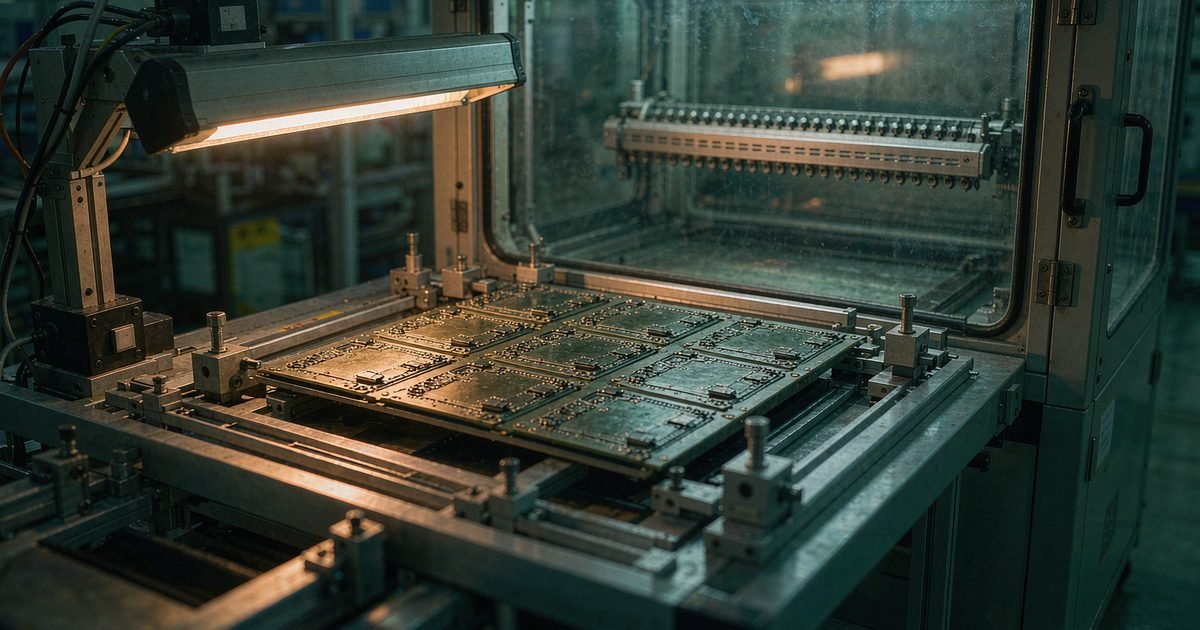
A conformal coating line can be perfectly dialled in and still produce boards that peel, bubble or grow dendrites under the film. The coating process gets investigated first and is almost never the culprit. Conformal coating adhesion failure starts upstream, at the surface the coating must bond to.
Here is the uncomfortable version: if your coating line is failing, you are probably not looking at the wrong settings. You are looking at the wrong department.
The Coating Is Not the Weak Point
A cured conformal coating is a good dielectric. It does what the datasheet says. What fails is the interface between the coating and the board, and interfaces are decided by whatever is sitting on the board at the moment of application.
Three things sit there, and none of them are visible on a normal visual inspection:
Ionic contamination. Flux activators, plating residues and handling salts left on the surface. Under a coating, these are sealed in. Any moisture that reaches them — and moisture always reaches them — turns them into an electrolyte. The failure mode is electrochemical migration under the film, which you discover months later.
Organic films and residue. Non-polar films left by some cleaning routes, release agents, fingerprints, and the residue layer that a partial clean leaves behind. These are what make the coating “not stick” in patches.
Particulate. Dust, solder micro-spheres and laminate debris. The coating flows over them, cures, and traps a void underneath.
This is why the failure pattern is so often patchy and repeatable in the same location. Good coating practice cannot compensate for a contaminated interface, because the coating never gets to see the interface it should have had.
Why the Wrong Cleaning Can Make It Worse
There is a trap here, and it catches experienced teams. Cleaning with a solvent that is chosen only because it dries fast can leave a residue film of its own. Wiping the board immediately before coating feels like thoroughness. If that wipe leaves a non-polar film or drives residue into via barrels, it has moved the contamination, not removed it. The board looks better. The interface is worse.
Surface energy is the honest measure here. A coating has to wet a surface to bond to it, and it can only wet what it can reach.
Failure Mode vs Where It Actually Starts
The table below is the diagnostic shortcut. Match the symptom you see, then look at the left column, not the right one.
| Symptom after cure | Usual first assumption | What it usually is | Where to look |
|---|---|---|---|
| Coating peels in patches | Coating material or cure profile | Organic film or residue layer under the coating | Pre-coating washing and rinse quality |
| Bubbles or voids in the film | Entrapped air, coating viscosity | Outgassing from residues, or particulate under the film | Surface cleanliness and pre-dry step |
| Dendrites or corrosion under the coating | Coating permeability | Ionic contamination sealed in by the coating | Ionic cleanliness before coating, acceptance criteria |
| Dewetting, coating pulls back | Surface energy too low | Contamination or an incompatible cleaning chemistry | Surface preparation method |
| Defects cluster at one board area | Board or design issue | Localised residue, handling contact or dust accumulation | Handling, storage and dust removal at that station |
Read the table one more time and notice something. Not one of these rows resolves inside the coating booth. Every repair path runs upstream, and the white residue problem after soldering is the same story told from the cleaning side.
A note on what “clean enough” means here
There is no single universal numeric limit you can dial in and forget. IPC J-STD-001 no longer fixes one uniform ionic contamination value; the standard moved to establishing acceptance criteria through surface insulation resistance testing, historical field evidence and humidity-bias testing. For a coating line, that means the cleanliness specification has to be written for the product’s reliability class and its end environment, following IPC’s published guidance rather than copying a number from an old datasheet.
That is a harder conversation than picking a threshold. It is also the only one that holds up.
What a Pre-Treatment Step Has to Control
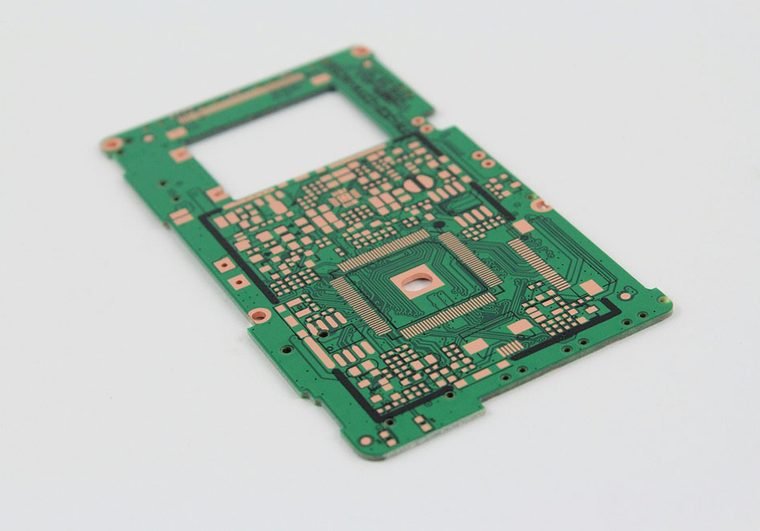
Treat the pre-coating surface as a process step with defined parameters, not as a preparation ritual.
1. Identify the contamination before choosing the method. Flux chemistry drives the decision. An aqueous detergent route is selected for the flux and residue types actually present on the line, not because it is convenient. Ask the flux supplier and the detergent supplier to confirm compatibility.
2. Control the wash, not just the wetting. Temperature, detergent concentration, mechanical action and contact time each do work. If any one is neglected the others cannot compensate. This is the step where a written parameter set beats operator judgement.
3. Control the rinse. Residue that is released but not carried away is still on the board. Rinse quality is the parameter most often left undocumented, and it is the one that decides whether the interface is clean or merely rearranged.
4. Control the dry. Moisture left under a coating becomes a void, and a void becomes a crack path. Drying has to be specified and verified, not assumed from the fact that the board feels dry.
5. Control particulate separately. Dust removal is a different mechanism from residue removal, and it needs its own station. A non-contact dust removal step immediately before the coating line is what keeps the particulate contribution out of the defect budget.
6. Record it. If the customer audits the coating process — automotive, medical and industrial customers do — the pre-treatment step needs parameters and records like any other process. “Cleaned as needed” is not a process.
7. Handle and store accordingly. A board that is clean and then sits open in a coating area does not stay clean. Bagging, racking and hold-time limits belong in the procedure.
On the equipment side, this is what the CHUANGQI Substrate Cleaning & Dust Removal Machine (CQ-CL350S) is specified for: board cleaning and dust removal ahead of a downstream process, with load configuration sized to the line rather than to a generic figure. Where surface activation is required rather than removal, the CHUANGQI Plasma Cleaner addresses the surface state directly. Both fit inside the cleaning applications we build for.
Pre-Treatment Questions Engineers Actually Ask
Does conformal coating really need a clean board?
Yes, and “clean” here means ionically clean plus free of organic film and particulate. The coating determines the dielectric properties; the surface determines whether the coating stays bonded to the board. Coating over contamination only moves the failure earlier in the product life.
Why does the coating peel off only in some areas?
Because contamination is localised. Fingerprints at a handling point, dust that settles on one section of the panel, or residue that concentrates at a specific geometry will all produce patchy de-wetting. The pattern is diagnostic — it usually points at a handling, storage or dust-removal gap rather than at the material.
Can we wipe with IPA right before coating?
An IPA wipe can remove fresh, soluble residue, but it is a poor substitute for a defined wash, rinse and dry sequence. Depending on the flux chemistry it can leave its own film or push residue into vias and blind holes. If a wipe is part of your process, it needs a validated procedure behind it, not an operator’s judgement.
How do we know the surface is ready?
Define acceptance before production, not after a failure. Typical routes are a cleanliness check against the criteria set for the product class, water-break or surface-energy checks for wetting behaviour, and a first-article coating inspection for coverage and adhesion. Whichever route you choose, document it and re-verify when the flux, the detergent or the supplier changes.
What do we need to specify to get a coating-line pre-treatment quote?
Board dimensions and maximum panel size, throughput per shift, the flux chemistry in use, the cleanliness criteria you have to meet, and the line layout around the coating booth. With those we can size the pre-treatment equipment and quote within 24 hours. Send the board and the process data and we will tell you which pre-treatment step is the gap.
If your coating defects trace back to the surface, start with the dust removal and surface preparation step rather than with another coating trial.