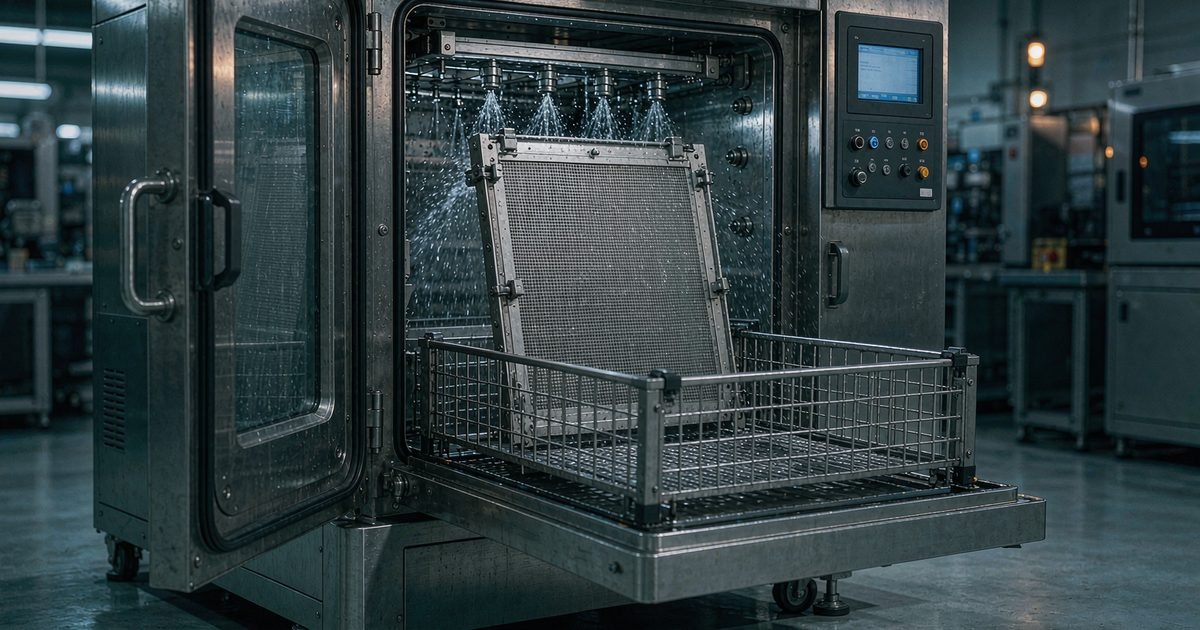
A stencil cleaning machine is shortlisted by the largest frame it accepts, and that number hides the rest of the decision. Match the machine to the frame you actually print, then to the frames per shift you need, then to the utilities already standing at the installation point.
CHUANGQI publishes a specification sheet for every stencil and screen cleaning machine it builds. The two tables below are read line by line from the published sheets of five models — CQ-C740, CQ-C750S, CQ-C750, CQ-C730S and CQ-C730. Every figure is a nominal datasheet value, not a measurement taken on a customer’s stencils.
Key takeaways
- Largest frame and hourly output are two separate decisions.
- Five CHUANGQI cleaners take a 750 × 750 × 40 mm stencil frame.
- The CQ-C740 runs wash, rinse and dry at 2–8 minutes each.
- Three-stage filtration at 10, 5 and 1 µm keeps paste out of the bath.
- Match utilities before ordering: 380 V and 0.45–0.7 MPa air.
Frame Size Sets the Basket; Output Sets the Machine
Scope first. This comparison covers basket-type stencil and screen cleaning machines, on the published specification sheets of five CHUANGQI models. It excludes inline board washers, and it states no cleaning result: whether every aperture comes out open depends on your paste, your wipe discipline and your bath control, not on the basket capacity alone.
Frame size is the entry ticket. If the largest stencil in the printing area does not fit the basket, nothing else about the machine matters. All five models in the table below accept the same 750 × 750 × 40 mm frame, so on frame size alone they are interchangeable — which is exactly why the decision has to be made on the three rows underneath.
| Model | Max stencil frame | Cycle as published | Wash bath |
|---|---|---|---|
| CQ-C740 electric, rotating spray arms | 750 × 750 × 40 mm; larger on request | Wash, rinse and dry, 2–8 min each | 2 × 42 L max, 35 L optimal charge per tank |
| CQ-C750S dual-frame | 2 × 750 × 750 × 40 mm per cycle | Spray wash – spray rinse – high-pressure air knife | 2 × 42 L wash and 2 × 42 L rinse |
| CQ-C750 multi-function spray | 750 × 750 × 40 mm; above 760 mm custom | Spray wash – spray rinse – high-pressure air knife | 2 × 42 L wash and 2 × 42 L rinse |
| CQ-C730S automatic screen | 750 × 750 × 40 mm; oversize on request | Wash 2–4 min, dry 2–5 min | 40 L max |
| CQ-C730 pneumatic | 750 × 750 × 40 mm; oversize on request | Wash 2–4 min, dry 2–5 min | 40 L max |
Source: CHUANGQI stencil cleaning machine specification sheets, 2026-10. Figures are nominal datasheet values; frames larger than the published maximum are quoted on request rather than promised.
Cycle Time, Bath Volume and Five Questions That Narrow the List
Hourly output comes from arithmetic on the published cycle, and the same machine spans a wide band depending on where you set it. On the CQ-C740, a 2-minute wash plus a 2-minute rinse plus a 2-minute dry returns one stencil every 6 minutes; the long end of the published range, 8 minutes per stage, returns one every 24 minutes. That is 10 stencils an hour at the bottom of the range against 2.5 at the top, from one machine and one datasheet.
Two consequences follow. First, quote output only at the cycle you will actually run: a printing cell that holds a stencil out of service for 24 minutes needs a second stencil in rotation, whatever the brochure says. Second, a twin-basket machine changes the arithmetic differently from a faster single-basket machine. The CQ-C750S cleans two 750 × 750 mm frames in one cycle, so it doubles frames per cycle without shortening the cycle itself — the right answer when two identical stencils come off the same line, and the wrong answer when the second basket would sit empty.
Bath volume sets how long the chemistry stays usable, and filtration decides what the bath is fighting. The CQ-C730S and CQ-C730 both run three cartridge stages at 10, 5 and 1 µm: the 10 µm stage takes debris and labels, the 5 µm stage takes solder paste and rosin particles, and the 1 µm stage takes the same particles at finer size. Paste that reaches the bath is paste that the rinse carries back onto the next stencil unless the cartridge train catches it first.
Run five questions against every candidate before you compare prices. They are ordered so that a single answer can remove a machine from the list.
- What is the largest frame profile on this line, including the 40 mm height? A frame that fits the footprint but not the profile is a frame that never gets cleaned.
- How many frames does one print shift consume, and how many will be in rotation at once? This decides single-basket against twin-basket more often than throughput does.
- Does the wash bath see solder paste every cycle, or only misprints and rebuilds? Paste load sets the filtration requirement, and the cartridge train is quoted separately from the machine.
- Which chemistry will the machine run, and does the bath material match it? The CQ-C740 isolates fluid between stages at 400–600 L/min; confirm the elastomers and seals against the cleaning agent you intend to use.
- What is already at the installation point? Power, plant air and a water supply decide whether the quoted machine is the installed machine.
Utilities and Footprint: the Check Most Buyers Run Last
Utilities are the cheapest thing to verify and the most expensive to discover late. A machine that needs 380 V where the line supplies a different voltage, or more plant air pressure than the compressor can hold, becomes a change order after the purchase order is signed.
| Model | Power input | Air and water supply | Net weight |
|---|---|---|---|
| CQ-C740 | AC 380 V, 50 Hz, 30 kW | Air 0.45–0.7 MPa; water 0.2–0.3 MPa | approx. 500 kg |
| CQ-C750S | AC 380 V, 50 Hz, 30 kW | Air 0.5–0.8 MPa; water 0.2–0.3 MPa | 500 kg |
| CQ-C750 | AC 380 V, 50 Hz, 30 kW | Air 0.5–0.8 MPa; water 0.2–0.3 MPa | 500 kg |
| CQ-C730S | Not listed on the published sheet | Air 0.4–0.6 MPa; air consumption 400–600 L/min | 300 kg |
| CQ-C730 | Not listed on the published sheet | Air 0.4–0.6 MPa; air consumption 400–600 L/min | 300 kg |
Source: CHUANGQI stencil cleaning machine specification sheets, 2026-10. Rows marked as not listed reflect the published sheet as it stands; ask for the current value rather than assuming one.
Floor loading belongs in the same conversation as the utility list. A 500 kg machine on a suspended floor, or a 300 kg machine that has to be carried up a service stair, changes the installation plan more than a small difference in rated power does.
Limits of applicability. This comparison is not suitable as the only input where the stencil is cleaned inside a fully automated printing cell with its own handling robot: there the basket is one interface among several, and the cell’s gripper sets the frame profile that has to fit. It also does not cover board cleaning, and it states nothing about the result on one specific solder paste. Where the open question is whether a stencil comes out clean rather than which machine fits, the answer comes from a sample run on your own stencils, not from a wider table.
Two related pieces on this site pick up where this leaves off. If the open question is whether a machine beats manual wiping at all, stencil wiping against machine cleaning on total cost works through that comparison. If the problem you are solving is a specific defect rather than capacity, what clogs a fine-pitch stencil traces the cause back to the printing step. The model used most often as the reference for a single-frame printing cell is the CQ-C740 electric stencil cleaning machine.
Frequently asked questions
What size stencil will a stencil cleaning machine take?
The five CHUANGQI stencil and screen cleaners above are published at 750 × 750 × 40 mm, and the CQ-C750S takes two frames of that size in one cycle. Frames above the published maximum are quoted on request, so send the exact outer dimensions and the frame profile height rather than the nominal size alone; a 40 mm profile with a grip bar is the measurement that decides whether the frame loads cleanly.
How long does a stencil cleaning cycle take?
Published figures run from 2 to 8 minutes per stage on the CQ-C740, against 2–4 minutes wash and 2–5 minutes dry on the CQ-C730S and CQ-C730. Stage times are set on the machine, so a cycle quoted at the fast end assumes the stencil and the paste tolerate the short end. Neither figure includes the time an operator spends carrying the frame to and from the machine, and that time belongs in the same output calculation.
Can one machine clean two stencil frames at once?
Yes, if the machine is built for it. The CQ-C750S is a twin-basket design and cleans two 750 × 750 mm frames per cycle; the single-basket models take one. A twin-basket machine earns its footprint when two stencils come out of service together, and it is the wrong machine when the second basket stays empty through a shift.
Do I need 380 V and compressed air for a stencil cleaner?
It depends on the model, and the published sheets differ. The CQ-C740, CQ-C750S and CQ-C750 are listed at AC 380 V, 50 Hz with 30 kW, plus air at 0.45–0.7 MPa or 0.5–0.8 MPa depending on the model, and a water supply at 0.2–0.3 MPa. The CQ-C730S and CQ-C730 sheets list an external air supply of 0.4–0.6 MPa and air consumption of 400–600 L/min. Confirm every utility against the installation point before the order, because a voltage or pressure mismatch is not something the machine can absorb on site.
Next step: send the largest stencil frame on your line, the frames you clean per shift and the utilities at the installation point. The reply names the model that fits those three answers, and it carries a quote within 24 hours — open a stencil cleaning machine selection.