
Setting rinse and dry parameters for heavy-copper assemblies is a different job from setting them for a standard double-sided board. A PCBA washer is a conveyor machine that moves a part through wash, rinse and dry zones at a fixed belt speed; when the part carries thick copper planes, its thermal mass rises and both the rinse and the dry stage behave differently at the same settings.
This guide covers the three parameters to set first on a water-based conveyor washer — conveyor speed, rinse stage condition, and dry stage condition — and the variables each one actually depends on. It is aimed at process engineers running high-layer-count, heavy-copper or large-format assemblies through an inline washer such as the CQ-C9610.
Key takeaways
- Thick, heavy-copper assemblies usually fail at rinse and dry, not at wash.
- CQ-C9610 runs 0–1500 mm/min across a 580 × 450 × 80 mm part window.
- Rinse quality depends on water quality, stage count and board geometry.
- Some large panels should not use standard rinse-and-dry settings.
Why Thick Boards Need Different Rinse and Dry Settings
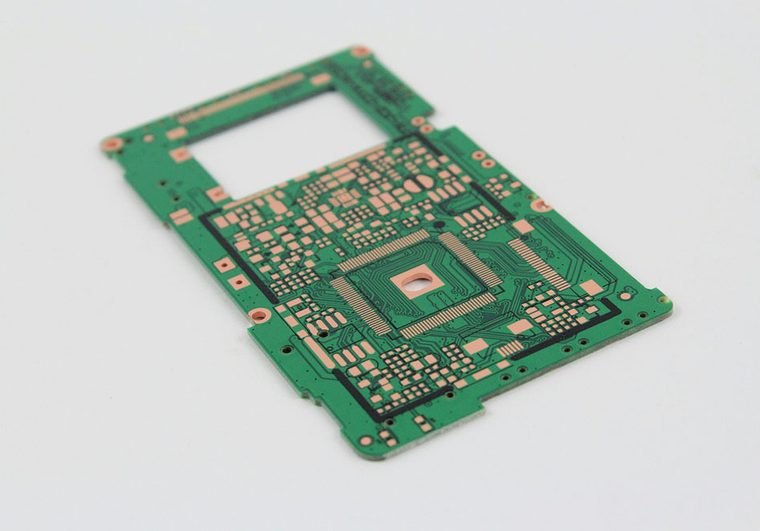
The core entity here is the heavy-copper assembly: a printed circuit board assembly (PCBA) that carries copper weights well above the standard one-ounce signal layer, often with power and ground planes of two ounces or more alongside thin signal layers on the same board. This mix is what makes post-assembly cleaning a parameter problem rather than a chemistry problem.
Three properties change when copper weight and board thickness rise, and each is measurable on the board itself:
- Thermal mass. Copper weight is printed on the stack-up drawing, and a heavier stack holds more heat from the wash and rinse stages. It therefore reaches the dry stage hotter and wetter than a thin board at the same belt speed.
- Z-height and shadowing. Taller components narrow the clearance the rinse spray must reach through, and that clearance is measurable as the gap between the component body and the board surface.
- Water retention in vias and heavy planes. Plated through-holes and plane layers hold residual moisture after the spray has passed, and the effect scales with via count and board thickness.
The consequence is asymmetric: the wash stage may look adequate while the rinse and dry stages leave residue and moisture behind. When vias sit above the part’s mid-plane, slowing the conveyor alone rarely clears a wet exit.
Basis: the mechanisms above are described from machine geometry and from the published specification data for CHUANGQI conveyor washers. No external numeric claims are used.
Three Parameters to Set First — and the Variables Each One Depends On
Set these in order. Each one constrains the next.
Conveyor speed. On a conveyor washer the belt speed sets the dwell time in every zone at once, so it is the master parameter. CQ-C9610 is documented across a belt band running from 0 up to 1500 mm per minute, with the largest accepted part measuring 580 mm wide × 450 mm long × 80 mm high. Moving to the slow end increases dwell but also lengthens the thermal exposure. This value depends on the part’s thermal mass, its component height, its via density, and the rinse water temperature. It does not depend on board length alone.
Rinse stage condition. The rinse stage’s job is to carry away the ionic content the wash released. Its capacity is set by water quality, by how many rinse stages run in series, and by the flow available to each. The CQ-C9610 carries a deionized (DI) water rinse rated above 15 MΩ, fed at a DI-water inflow of 1.0 m³/h, and the stage consumes 10–16 L/min of DI water while running. This value depends on the incoming DI-water resistivity, the drag-out from the wash stage, the board’s surface area, and the rinse stage count. Resistivity at the tank outlet is the reading that tells you whether the stage is keeping up.
Dry stage condition. Drying removes what the rinse leaves. On the batch counterpart CQ-C743 the drying temperature reaches up to 99 °C, and spray pressure runs 30–40 psi. On a conveyor machine the dry zone length and the air-knife arrangement do the work. This value depends on the belt speed through the dry zone, the board’s heat capacity, the ambient humidity in the plant, and component geometry that traps moisture.
The three parameters interact, which is why changing one in isolation tends to move the problem rather than solve it.
| Parameter | Primary setting | Depends on (≥3 variables) | Reading to watch |
|---|---|---|---|
| Belt speed | documented 0 to 1500 mm/min (CQ-C9610) | Thermal mass, component height, via density, rinse water temperature | Exit moisture, not belt speed |
| Rinse condition | DI rinse, >15 MΩ rated, 1.0 m³/h inflow, 10–16 L/min draw (CQ-C9610) | Incoming resistivity, wash drag-out, board surface area, stage count | Tank-outlet resistivity |
| Dry condition | Up to 99 °C dry temperature (CQ-C743) | Belt speed in dry zone, board heat capacity, plant humidity, trapped-moisture geometry | Board exit temperature and surface dryness |
Basis: the ranges quoted above are copied from the datasheets of CQ-C9610 and CQ-C743. The variable lists come from field experience and you should confirm each one against a baseline run on your own line.
Where These Settings Stop Working
The honest boundary matters more than the starting numbers, because applying these settings outside their range is where boards get damaged.
- Very large panels. A panel wider than the machine’s part window cannot be run at standard settings at all; it will not pass the spray bars evenly. This is a fit question, not a parameter question.
- Boards with moisture-sensitive components. Raising dry temperature to push moisture out can exceed the component’s reflow or storage profile. When that happens, extend the dry zone time instead of raising temperature.
- Assemblies with conformal coating applied on the same line. Coated boards need a different rinse and dry logic, and standard settings may not be appropriate.
Not suitable for: these starting points assume a water-based conveyor washer, a part that fits the machine’s stated window, and components rated for the dry temperature used. They do not apply to solvent machines, to dry-ice blasting, or to assemblies whose moisture-sensitive devices are not rated for the dry-stage temperature.

A Parameter Sheet You Can Start From
Use this as a first-pass sheet, then tune against your own exit readings. Every value below is a machine-documented range, not a recommended production setting.
| Stage | Documented range (source) | First-pass action |
|---|---|---|
| Belt speed | 0 to 1500 mm/min (CQ-C9610) | Start mid-band, then slow only if rinse-out is incomplete |
| DI rinse | >15 MΩ rated, 1.0 m³/h inflow, 10–16 L/min draw (CQ-C9610) | Confirm resistivity holds at the tank outlet |
| Dry (batch) | Up to 99 °C (CQ-C743) | Raise only within component ratings |
| Spray pressure (batch) | 30–40 psi (CQ-C743) | Verify against commissioning baseline |
FAQ
Why is my board still wet at the exit of the washer?
Moisture at the exit usually points to the dry stage rather than the wash. Check the board’s exit temperature, the belt speed through the dry zone, and whether vias or heavy planes are trapping water. Raising temperature is not always the answer — moisture-sensitive components may cap that.
Should I slow the conveyor down or raise the drying temperature?
Slow the conveyor first if rinse-out is incomplete; the speed affects dwell in the rinse and dry zones together. Raise drying temperature only when the component ratings allow it, and prefer extending dry-zone time where they do not.
How many rinse stages does a heavy-copper assembly need?
Stage count is set by the ionic load the wash leaves behind and by the incoming water quality, not by copper weight alone. Watch the rinse tank’s outlet resistivity to judge whether the current stage count is keeping up.
Does this apply to large panels as well as thick boards?
Partly. Large panels add a fit constraint — they must pass the machine’s stated part window — in addition to the thermal and rinse considerations that apply to thick boards.
If you want these starting points tuned to your own board stack and component mix, send us your stack-up and panel size and we will return a first-pass parameter sheet for your line. The mechanism behind these settings is covered in more depth in our guide to why high-layer-count and heavy-copper boards defeat a standard cycle, and the diagnostic side is covered in the poor cleaning results troubleshooting tree.