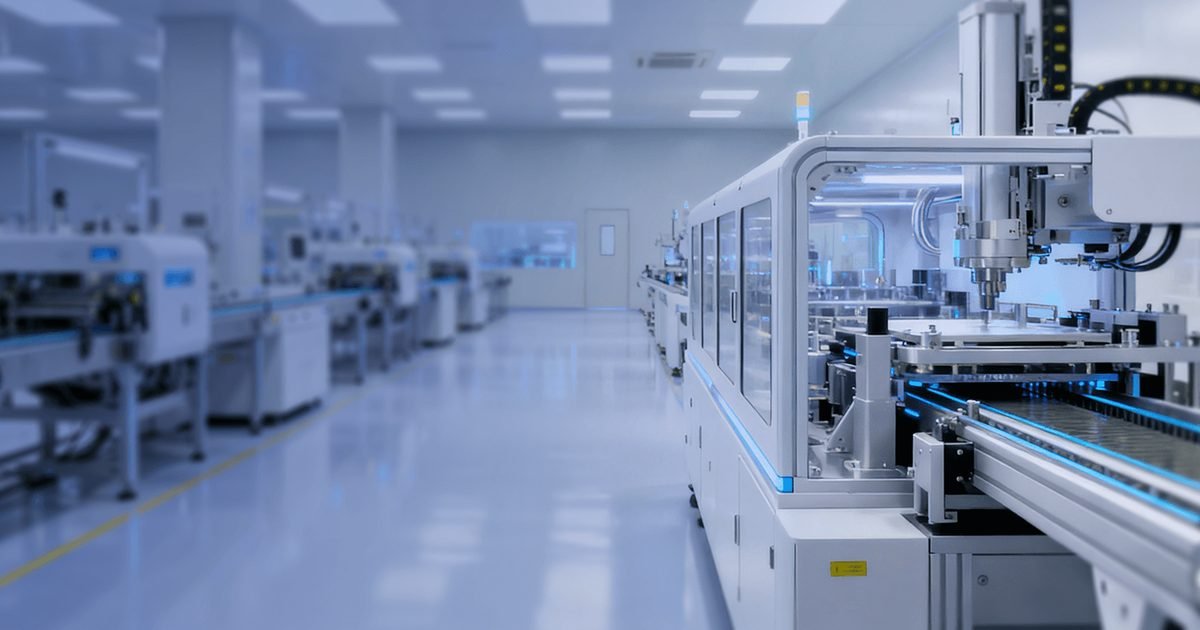
PCBA cleaning on a power-electronics line is judged by the wrong target. The step was sized for consumer boards and is now expected to satisfy a wire bond, so residue survives under the package. Re-derive the step from the flux class, not from the board’s size.
CHUANGQI builds the wash–rinse–dry platforms and the water-based cleaning fluid used on those lines. The reference window below is taken from the published datasheet of CHUANGQI’s inline PCBA water cleaning platform, model CQ-C9610, and from our water-based cleaning fluid product sheet. Every number is a nominal datasheet value, not a result measured on your boards.
Key takeaways
- The process after cleaning sets the acceptance target, not the board size.
- Rosin, water-soluble and no-clean residues behave differently in the wash stage.
- The CQ-C9610 reference window moves workpieces at 0–1500 mm/min.
- Rinse quality is a water specification before it is a machine specification.
- A batch machine is the wrong tool for a line-paced power-electronics flow.
Power Electronics Did Not Change the Cleaning Step; It Changed What Counts as Clean
Scope first. This note covers assemblies whose next process step is sensitive to what sits on the surface — wire bonding, sintering, encapsulation or coating — and it uses the published CHUANGQI platform specifications as the reference for what a wash, rinse and dry stage can hold. It states no residue limit of its own, because that limit belongs to the product class and to the customer, not to a machine datasheet.
Here is the part the industry keeps stepping past. When a cleaning step on a power-electronics line disappoints, the instinct is to blame the washer, and the washer is usually the least interesting suspect. The more common cause is an acceptance target that was written for a different product: a target set when the assembly’s next step was a visual inspection, then applied unchanged when the next step became a bond that fails quietly under thermal load.
Cleaning is the last process before the truth comes out. Nothing downstream can compensate for a surface that was left contaminated, because the bond, the sinter layer and the encapsulation all form on that surface and inherit it. A washer sized against a visual standard is not a washer that failed; it is a washer asked the wrong question.
Two decisions follow. First, the acceptance target has to be stated in terms of the next process, not in terms of appearance. Second, cleaning chemistry has to be chosen from the flux class on the board, which is where the wash stage either removes the residue or merely moves it.
Flux class is the first branch point, and it is the one most often skipped when a line changes product. The three classes below are not interchangeable, and a chemistry that handles one of them well does not automatically handle the other two.
| Residue class | Behaviour in the wash stage | What it threatens downstream |
|---|---|---|
| Rosin and activated rosin flux residue | Dissolves slowly; needs heat and dwell time in the wash stage to come off | A tacky film that traps particles and blocks a bond or a coating from bonding |
| Water-soluble (organic acid) flux residue | Dissolves quickly in water, and can be carried back onto the board if the rinse is weak | Ionic material inside the bond area, where it drives corrosion under moisture and bias |
| No-clean flux residue | Designed to stay in place; the wash stage lifts only what the chemistry can wet and carry away | A hard, translucent film that survives a weak wash and appears later as a bond failure |
Source: CHUANGQI process application notes and product specification sheets, 2026-10. The table describes how each residue class behaves in a wash stage; it states no acceptance value for any of them.
The third row is where most surprises sit. A no-clean flux is formulated to be left on the board, which means it is formulated to resist removal. A line that switches to a power-electronics product without revisiting the chemistry keeps a wash stage that was adequate for the previous assembly and now fights a residue it was never sized against.
Rinse and Dry Are Decided by the Next Process, Not by the Board
After the wash stage has lifted the residue, the rinse stage decides where it ends up. Rinsing that is under-specified removes the chemistry from the bath and returns part of the dissolved residue to the board as the water dries — and on a power assembly with a low-clearance package, the part that returns is the part the wash stage was working hardest to remove.
That is why the rinse specification is a water specification. Resistivity, flow and the number of rinse stages matter more than the machine’s chamber size, and all three are usually fixed by the plant upstream of the washer rather than by the washer itself. The reference window below shows the values published for the CQ-C9610 platform and, more usefully, what each value depends on.
| Parameter | Published value | Depends on |
|---|---|---|
| Maximum workpiece envelope | 580 × 450 × 80 mm (W × L × H) | Carrier or pallet design, and the tallest component on the assembly |
| Conveyor speed | 0–1500 mm/min | Paste load, flux class, and the dwell time your recipe needs in each stage |
| Cleaning fluid consumption | 1.0–2.5 L/h | Board area per hour, paste load, and the concentration you hold in the bath |
| DI water rinse flow | 10–16 L/min | The finest pitch you assemble and the number of rinse stages you run |
| DI water resistivity | >15 MΩ | The water plant upstream of the machine, not the machine |
| Installed power | approx. 130 kW | Heater duty, conveyor load and the dry-stage setpoint you choose |
| Machine weight | approx. 2600 kg | Floor loading and the route the machine takes into the building |
Source: CHUANGQI inline PCBA water cleaning machine specification sheet (CQ-C9610), 2026-10. Values are nominal datasheet figures and are not test results from any customer’s assemblies.
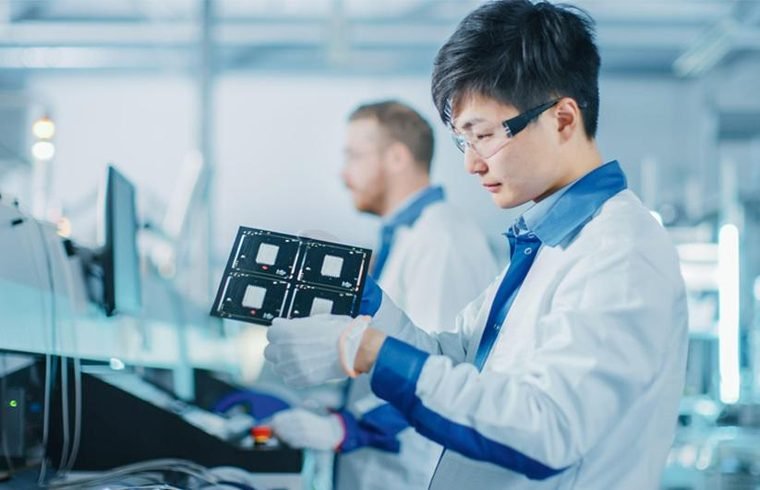
The dry stage closes the same logic. Moisture left under a package or inside a connector body carries dissolved residue back to the surface as it evaporates, which is the mechanism behind water marks and the film that reappears after a board looks dry. Hot-air drying belongs in the recipe as a specified stage with a specified dwell, not as the few seconds a board spends on the way out of the rinse.
Read further on this site if the question is still upstream. If the open question is what cleanliness target your product class should carry, how a cleanliness target gets set on a real line walks through who owns that number. The platform used for line-paced assembly in this note is the CQ-C9610 inline PCBA water cleaning platform, run with the water-based cleaning fluid matched to the flux class on the board.
Where This Method Stops Applying
Not suitable for assemblies carrying open-cavity sensors or unsealed components whose internal volume the rinse water can enter and the dry stage cannot clear: there the risk moves from residue to trapped moisture, and the answer is a masking and handling decision before it is a cleaning decision.
The method is also the wrong fit in three other situations. It does not apply where the cleaning step is inside a sealed atmosphere the board never leaves, because the rinse is then a different unit operation with different controls. It does not apply where the assembly is cleaned only to remove visible contamination before a cosmetic inspection, since the acceptance target is then appearance and the rinse specification can be relaxed. And it is not a substitute for a sample run: a published window tells you whether a platform can hold the envelope and the flow, not whether your specific residue clears under your specific recipe.
Frequently asked questions
Does flux residue matter on a power electronics assembly?
It matters wherever the next process forms a bond on the surface, and that covers wire bonding, sintering, encapsulation and coating. Residue that sits between the pad and the bond becomes part of the joint, and it changes how that joint behaves under moisture, bias and thermal cycling. On an assembly that goes straight to a visual check and into an enclosure, the same residue is a much smaller risk, which is why the two products do not share one cleaning specification.
Why is a water-based cleaning fluid used instead of a solvent?
A water-based fluid handles the polar residues that dominate after soldering, and it keeps the machine on a wash–rinse–hot-air dry sequence that ends with DI water rather than with a flammable bath that has to be extracted. The trade-off is real and worth stating: a water-based chemistry does not lift fully cured no-clean residue on its own, so where that class is present the wash stage has to earn it with heat, dwell time and filtration rather than with solvency alone.
What has to be checked before a power-electronics board goes to wire bonding?
Check the three stages separately, because they fail for different reasons. Confirm the wash stage reaches the flux class actually on the board, confirm the rinse leaves water at the resistivity your finest pitch needs, and confirm the dry stage clears moisture from under every low-clearance package. A single pass-or-fail result hides which of the three stages is the limiting one, and it is the limiting stage you have to fix.
When is a batch cleaning machine the wrong choice?
A batch machine is the wrong tool when the cleaning step has to keep pace with a flow that never stops. On a line-paced power-electronics flow, a batch washer puts assemblies into a queue and takes them out of it, which turns cleaning into a buffer and hides its own throughput behind that buffer. A batch platform earns its place on rework, prototypes and low-volume builds, where the queue does not exist to begin with.
Next step: send the flux class on the board, the package height and the process that follows cleaning, and we will confirm which wash, rinse and dry configuration fits that combination with a quote within 24 hours — start with a power-electronics cleaning review.