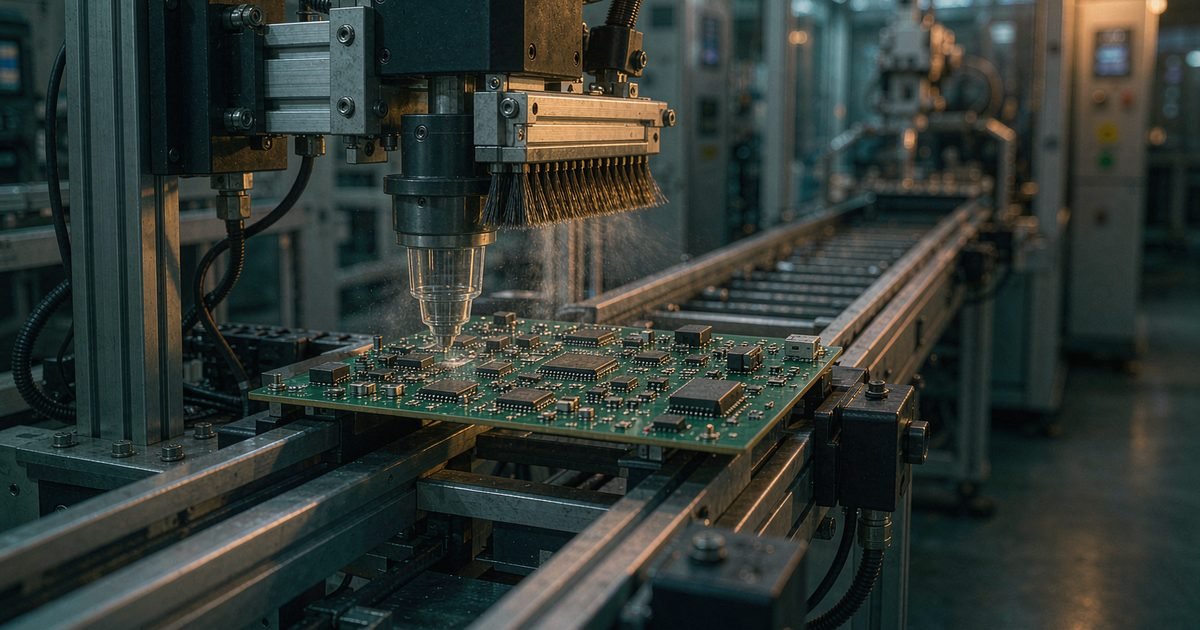
Conformal coating is a barrier film; the question buyers actually ask is whether that barrier makes the wash step redundant. To clean before conformal coating is to decide what stays sealed under the film, so the five checks below settle whether the wash step can be dropped.
Those checks map onto equipment CHUANGQI builds and verifies: substrate cleaners that combine brush, vacuum and adhesive-roll stages for boards from 90 × 50 mm up to 350 × 250 mm, water-based washers whose deionized (DI) rinse is rated above 15 MΩ, and a pre-shipment routine that includes spray-pressure calibration, a 72-hour endurance run and ionic cleanliness verification on test boards.
Key takeaways
- A conformal coating is a barrier film, not a removal process for residue.
- IPC J-STD-001 Revision H includes a chapter on cleaning and residue requirements.
- The single numeric industry limit was withdrawn from that standard in 2018.
- Five checks decide whether the pre-coat wash step can be dropped.
Why a Coating Cannot Stand In for Cleaning
Method and scope. This article covers the decision that sits between assembly and coating: whether the pre-coat cleaning step is required, reduced or removed. Machine values quoted below are taken from published CHUANGQI product specifications; they are machine limits, not settings we recommend for production. Standard references describe structure only; no compliance claim is made about any machine or line.
A conformal coating is a thin polymer film applied over an assembled printed circuit board to protect it from moisture, condensation and contamination in service. Its mechanism is exclusion: it keeps the service environment away from the surface. That mechanism has one requirement, and the requirement is the whole argument — the surface under the film has to be clean at the moment it is sealed.
Residue does not disappear when it is covered. Ionic residue trapped under a coating stays as a hygroscopic layer between the laminate and the film, and the two failure paths are well documented in electronics reliability work: adhesion loss at the interface, and long-term electrical instability when moisture eventually reaches the residue through a defect or an edge. Neither path is repairable, because repairing it means removing the coating.
The standards landscape has moved in the same direction. IPC J-STD-001 Revision H carries a dedicated chapter on cleaning and residue requirements (chapter 8), with a companion white paper in IPC-WP-019B; its current structure asks a process to establish and monitor its own acceptance basis rather than to match one universal number (per IPC, ipc.org). The single numeric limit that was quoted for years in supplier documents was withdrawn from the standard in 2018. Anyone still citing it as a requirement is working from a superseded text.
Five Checks to Run Before You Drop the Wash Step
Check 1 — Define what the coating must exclude. Start from the service environment, not from the coating. Condensing humidity, salt atmosphere, temperature cycling and customer-specific test requirements each change how much surface residue the design can tolerate. If the answer is “the film covers everything”, the check has not been done.
Check 2 — Measure the surface, not the board. A coating bonds to a surface of adequate energy; a surface carrying a thin organic film bonds poorly no matter how clean it looks. Wetting behaviour before and after the cleaning step is the measurable proxy, and it is also the fastest indicator that a cleaning stage has drifted.
Check 3 — Separate particulate from ionic load, because they need different removal. Dust, fibre and solder spatter are removed mechanically — the substrate cleaning and dust removal machine CQ-CL350S uses brush roll, vacuum and adhesive rollers across a documented board range of 90 × 50 mm to 350 × 250 mm, customizable for other formats. Activator salts from flux need an aqueous wash followed by a DI rinse; the conveyor washer CQ-C9610 is published with a rinse rated above 15 MΩ: the stage pulls 10–16 L/min of DI water from a feed line supplying 1.0 m³/h. Treating one as the other is the most common reason a coating line still sees adhesion failures after cleaning was “already done”.
Check 4 — Map masking and keep-out zones before deciding. Masking defines where the film is absent, and those boundaries are exactly where residue and moisture concentrate. A reduction in the cleaning step changes the interface at every boundary, so the decision belongs with the masking plan rather than with purchasing.
Check 5 — Read the coating’s own failure signatures. Dewetting, pinholes, blistering and adhesion loss at edges are coating defects with a cleaning cause. When they appear, the useful response is to re-verify the surface prep, not to change the coating supplier.
What Each Pre-Coat Step Removes — and What It Cannot
The table below sorts the pre-coat work by contamination class rather than by machine type, because that is how the decision is actually made.
| Contamination class | Removal mechanism | Documented reference (source) |
|---|---|---|
| Particulate: dust, fibre, spatter | Contact brush roll, vacuum and adhesive rollers | Board range 90 × 50 – 350 × 250 mm (CQ-CL350S) |
| Ionic residue: flux activators | Aqueous wash followed by DI rinse | DI rinse rated >15 MΩ; feed 1.0 m³/h; draw 10–16 L/min (CQ-C9610) |
| Entrained moisture | Hot-air dry stage, verified for temperature uniformity | Dry stage up to 99 °C (CQ-C743); uniformity test in the pre-shipment routine |
| Organic film, low surface energy | Surface activation before coating | Plasma cleaner for atmospheric surface treatment |
Source: CHUANGQI product specifications as published, plus the pre-shipment acceptance routine. Figures are published machine limits, not production recommendations.
A pre-coat process is credible when each row has an owner and a proof. Particulate is judged visually or with a tape check; ionic residue is judged by the cleanliness verification method your customer accepts; moisture is judged at the machine exit; and surface energy is judged by wetting. Where a row has no proof, that row is the gap to close before reducing anything.
Where This Does Not Apply
Three boundaries are worth stating plainly. First, this reasoning is written for assemblies that are coated after soldering; a product that is not coated at all is outside it. Second, it assumes an aqueous or mechanical pre-coat process — dry-ice blasting and other non-aqueous preparation do not carry a bath to qualify, so the checks reduce to surface result and proof. Third, and most important: it is not suitable for replacing a customer acceptance specification. If the drawing or the contract names a verification method, that method governs the decision, and this guide only helps you prepare for it.
One practical limit remains. A coating decision made on one board family does not transfer to the next. Different flux chemistries, different component heights and different masking plans each move the answer, which is why the five checks are written as a repeatable sequence rather than a one-time verdict.
FAQ
Can conformal coating replace cleaning?
No. A coating excludes the service environment; it does not remove what is already on the surface. Residue sealed under the film remains between the laminate and the coating, where it affects adhesion and long-term electrical behaviour, and it cannot be removed without stripping the coating.
If the flux is labelled no-clean, do we still need to wash before coating?
The label describes what the flux leaves behind, not what your coating requires. Where a coating follows, the surface condition at the interface governs the decision, and the accepted way to settle it is a verification method agreed with the customer rather than the flux classification alone.
How do we prove the surface is clean enough before coating?
Pick the method your customer accepts, run it on boards that have travelled the real process, and record the conditions with the result. Ionic cleanliness verification on test boards is the method used in CHUANGQI’s own pre-shipment routine, and it exists precisely because a visual check alone does not answer this question.
Does the pre-coat cleaning step change for dust versus flux residue?
Yes, and that is the point of separating the contamination classes. Particulate is removed mechanically with contact and vacuum stages; ionic residue needs an aqueous wash and a DI rinse. A line set up for one class rarely handles the other without a change in the process.
If you are deciding whether to keep the wash step ahead of coating, send us your board format and coating process and we will return a pre-coat cleaning proposal with the verification step written in. The masking and handling side of the same line is covered in our guide to masking and pre-coat cleaning, and the upstream argument is set out in why coating lines need cleaning upstream.